
A Brief History Of The Bassoon: Chapter 3, Contrabassoon
Posted by Clair Cangialosi, DMA on Jan 13th 2026
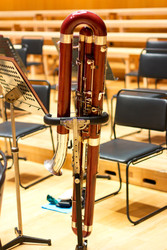
The contrabassoon is the lowest member of the woodwind family. It sounds an octave lower than written, and its folded bore measures approximately sixteen feet long. This post will explore its history and usage.
Table of Contents:
- Seventeenth Century
- Eighteenth Century
- Nineteenth and Twentieth Centuries
- Other Types of Contrabassoon
- Conclusion
- Works Cited
Seventeenth Century
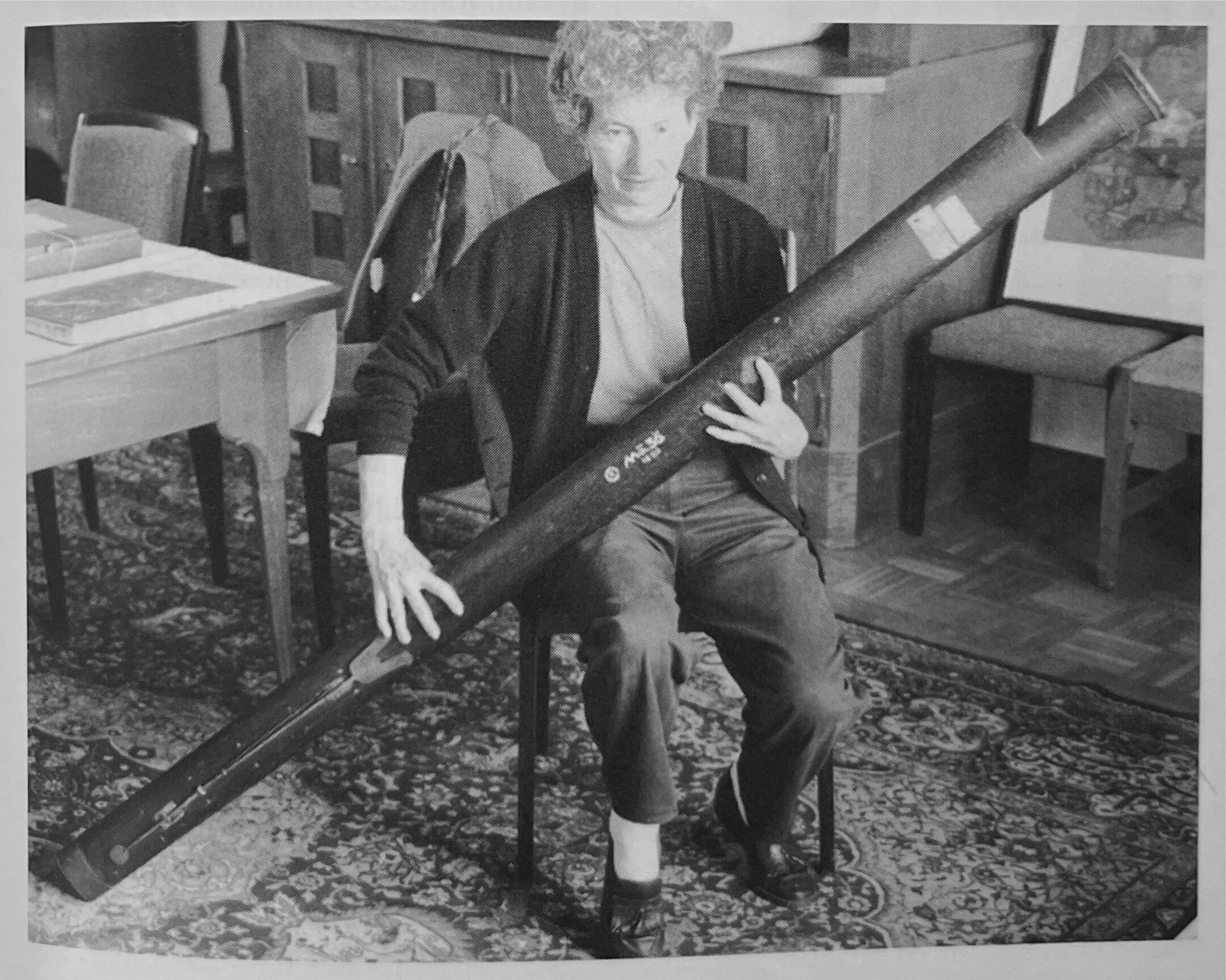
Just as with the bassoon and tenoroon, the contrabassoon traces its roots to the dulcian consorts of the late renaissance. Most common were the QuartFagot (descending to F2) and QuintFagot (descending to G2). These were often used interchangeably depending on the key of the piece. Although they were usually used to double an octaver below the written bass, they sometimes replaced the bass dulcian if the bass part laid low in the bass range, but more comfortably in the sub-contra range. In 1620 Michael Paetorius also described a very rare Fagotcontra or Octavbass dulcian, pitched one octave below the standard bass dulcian. These extra-large instruments were usually built in two or three pieces (to avoid mistakes when reaming such a long bore), and were then glued together. (1) An example of an octavbass dulcian is shown in figure 1, below.
The Eighteenth Century
The first true contrabassoons- constructed with four joints as with the baroque bassoon- were seen in France as early as the 1680’s, and there are several instruments which survive in museum collections from the turn of the 18th century. Figures two and three show two examples: a contra dating 1714 by A. Eichentopf, and a unique instrument from 1723 made by Johannes Maria Anciuti. A reconstruction classical contrabassoon can also be heard in the video below.
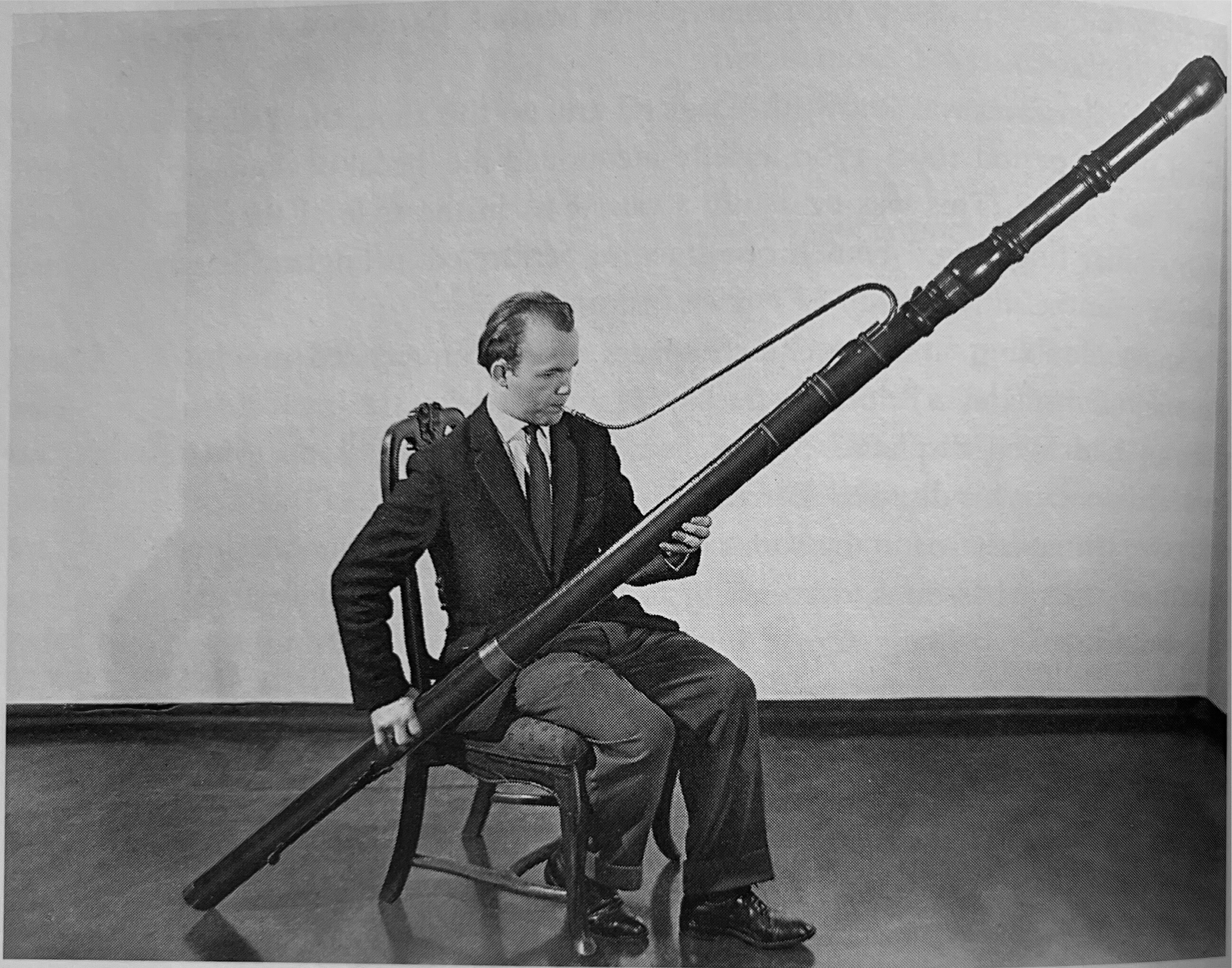
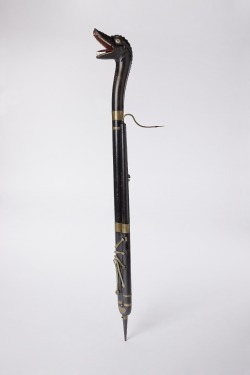
During the Classical Era, the contrabassoon underwent many developments, similarly to its smaller siblings. Since these instruments were still shaped like overgrown bassoons, makers had to find ways to reduce the weight on the left hand, especially as certain toneholes were moved out of reach of an average fingerspan and keys were added. As instruments and technique standards began to improve, composers began to write more independently for the contrabassoon. These instruments varied considerably between makers, but most had between five and nine keys.(2)
Mozart wrote for contrabassoon (but no bassoons) in his Mauerische Trauermusik K. 477.
Beethoven also wrote for contrabassoon in his fifth and ninth symphonies.
The Nineteenth and Twentieth Centuries
As with the bassoon, innovations to the contrabassoon were the most pronounced during the nineteenth century. At first, many of the improvements that were made to the bassoon, especially those by Carl Almenräder and later Wilhelm Heckel, were difficult to implement due to the size of the instrument. However, the rod-axle key, borrowed from Theobald Boehm’s flute design was a complete gamechanger for the contrabassoon. This system allowed for toneholes to be placed at acoustically accurate positions, covered by a key which was operated by a touchpiece some length away (see figure 3). With the use of this technology, instrument makers could remodel the contrabassoon to reduce its awkward length and extend the range down to B flat 1 (sometimes even A 1). What has become the modern standard contrabassoon design was developed by the Heckel firm between 1879 and 1900. (3)
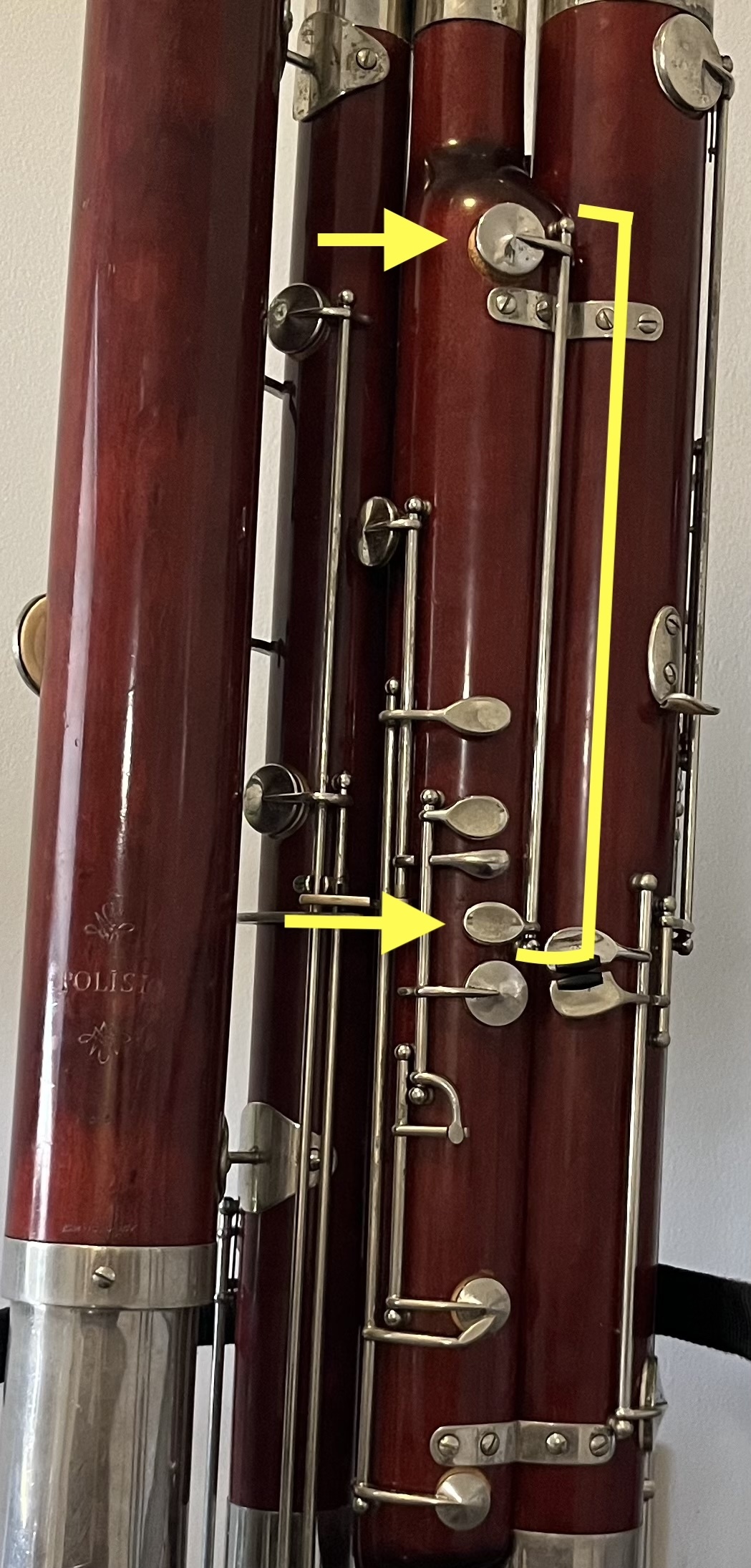
By the end of the nineteenth century, in the orchestra the contrabassoon functioned as a tonal bridge between the bassoons and low brass, provided reinforcement to the low strings, and was occasionally even given exposed solos. It was expected to handle parts requiring more agility and increased range- parts up to G and A 4 or higher were not uncommon. Late Romantic and Post Romantic composers of the late nineteenth and early twentieth centuries often wrote for increasingly larger orchestras, so it is not surprising that some of the most famous contra excerpts were written during that time period. A few of these are included below.
Brahms Symphony no. 1, op. 68 (1854):
Schoenberg Chamber Symphony no. 1 op. 9 (excerpt starts 04:32), 1906
Ravel, Mother Goose Suite, mvt 3 (1912)
Ravel, Piano Concerto For The Left Hand, 1930
Shostakovich, Symphony no. 5 op. 47, mvt 2 (excerpt starts 03:15), 1937
There is also a growing list of solo repertoire for contrabassoon. A small selection is included below.
Erwin Schulhoff, Bassnaghtigall (1922)
Victor Bruns, Concerto for Contrabassoon and Orchestra, op. 98 (1992)
Elaine Fine, Four Greek Myths (2004)
Dave Volpe, Oak Demon (2017)
Other Types of Contrabassoon
The Fast System
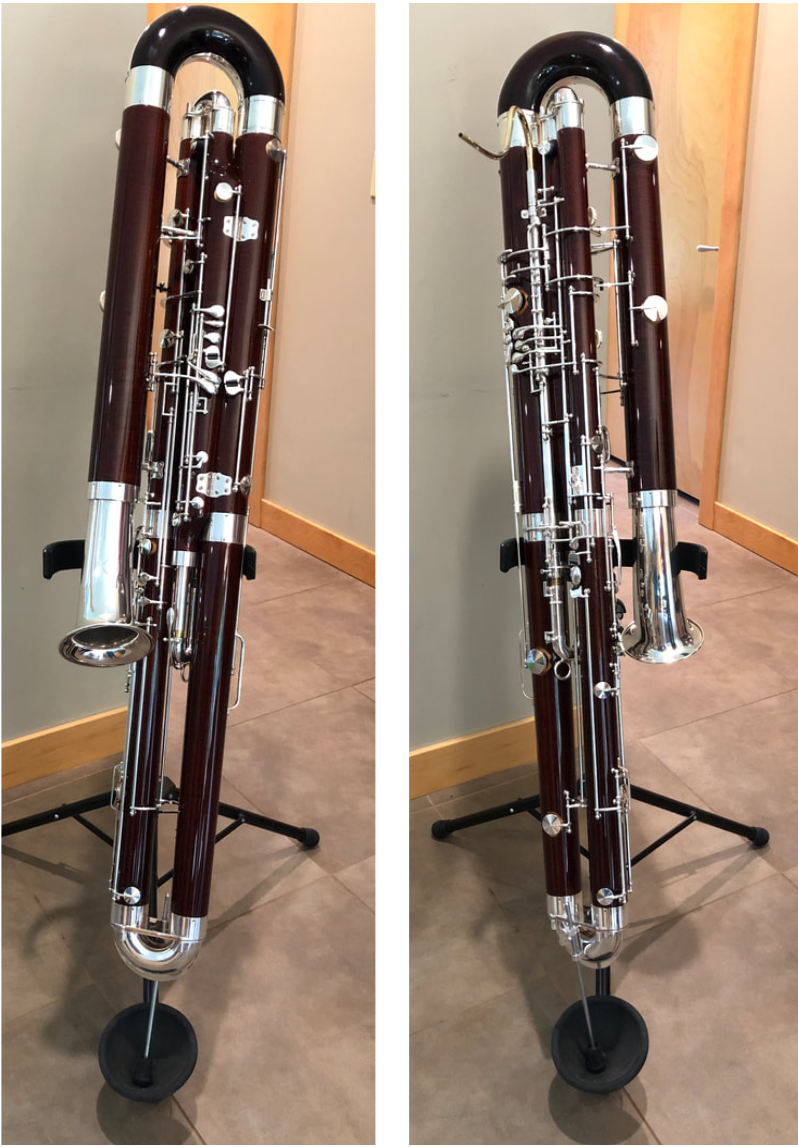
The “Fast System” was developed by Arlen Fast in the 1990’s and is manufactured by Fox Products. It is considered the first major redesign of the contrabassoon since the Heckel system was standardized at the turn of the 20th century. After winning his position with the New York Philharmonic Orchestra in 1996, Arlen Fast found himself struggling to play contrabassoon with the same beautifully even tone and clear articulation as he did on bassoon- and recordings confirmed that this was the norm for many other contra players as well. Driven to remedy the contrabassoon’s inherent acoustical faults, Arlen began researching and experimenting with modifying his own instrument. Eventually, he worked with Fox Products to finalize and begin manufacturing his updated design. In his publication, “Why It Was Time To Rethink The Contrabassoon,” Arlen Fast explains the details of his modified system, which primarily involves changes to the instrument’s mechanism to help reduce cracking on certain middle register notes, improve intonation and tone quality, and extend the upper range of the instrument. (4) Figure 4 shows a photo of a Fast System Contrabassoon.
Contraforte
The contraforte was designed by Guntram Wolf and Benedikt Eppelsheim in 2001. The goal of inventing the contraforte was to alleviate issues with projection and intonation that are inherent to the contrabassoon’s acoustics. The contraforte has a wider bore and shallower (non chimney) toneholes along with an automatic octave mechanism. While these aspects do create a more penetrating sound and wider dynamic range, they also sacrifice some of the essential characteristics of the traditional Heckel- type contrabassoon. The contraforte has a range from (sounding) A0 to C5- a half step lower and nearly a full octave higher than a standard contrabassoon. Below is a rare example of contrabassoon and contraforte being played together.
Conclusion
Mechanically speaking, the contrabassoon has come an exceptionally long way in the last few hundred years. Over time, the contrabassoon’s evolution was driven by many instrument makers and performers, in part by necessity, and in part by a fascination with the extremely low tessitura.
Interested in giving the contrabassoon a try? We’ve got everything you need to get started.
Questions? Contact us on our website. We’re happy to help!
Go to Introduction
Go to Chapter 1
Go to Chapter 2
Works Cited
- Kopp, James B. The Bassoon. New Haven, Yale University Press, 2012. 187-9.
- Kopp, James B. The Bassoon. New Haven, Yale University Press, 2012. 196.
- Kopp, James B. The Bassoon. New Haven, Yale University Press, 2012. 199-200
- Fast, Arlen, “Why It Was Time To Rethink The Contrabassoon.” The Double Reed, 2016.https://www.norapost.com/pub_recent/Time%20to%20Rethink%20the%20Contrabassoon.pdf.