
What Type of GSP Bassoon Cane Should I Buy?
Posted by Clair Cangialosi, DMA on May 18th 2026
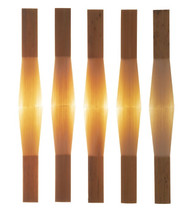
Here at Hodge Products, we stock over fifteen different types of gouged, shaped, and profiled bassoon cane. With so many options, it can be difficult to know if you’re choosing the correct one. This post will compare and contrast all of the gsp cane that we carry to help you choose. Skip straight to the Cane Descriptions section for a full breakdown of the measurements of each brand, or read on for more information.
Table of contents:
What Is GSP Cane?
GSP stands for gouged, shaped, and profiled. It is cane that is ready to be formed into a blank. Reeds made from GSP cane can be made without any special machines, although it does require the usual reedmaking tools. Most beginner reed makers will start with GSP cane, but advanced reedmakers may also choose to use it to save time.
Things to Consider:
With so many options, how do you choose the right gsp cane for you?
For new reedmakers, we recommend looking for something that is a similar shape to your current favorite reed. It is easier to prioritize a similar shape because the profile can be made thinner by scraping. A recommendation from a teacher or friend can also be helpful!
More experienced reedmakers should consider what, if anything, they are looking to change about their current reed style. Elements that can be adjusted by changing to a different reed shape are:
- General Intonation
- Response/ ease of playability
- Tone color
Wider shapes will generally be lower in pitch and favor the low register, while narrower shapes will tend to be higher in pitch and favor the upper register. We recommend making 20-30 reeds in one style to get an idea of how that reed design impacts your playing. Keep in mind that the overall length of the reed and wire placements will also have an effect on the outcome (although an in depth discussion of these variables is outside the scope of this post).
Helpful Definitions
There are many variables at play when it comes to choosing gsp cane. The most influential variables are the “coefficient of flare,” the shape type, and the profile type.
Coefficient of Flare
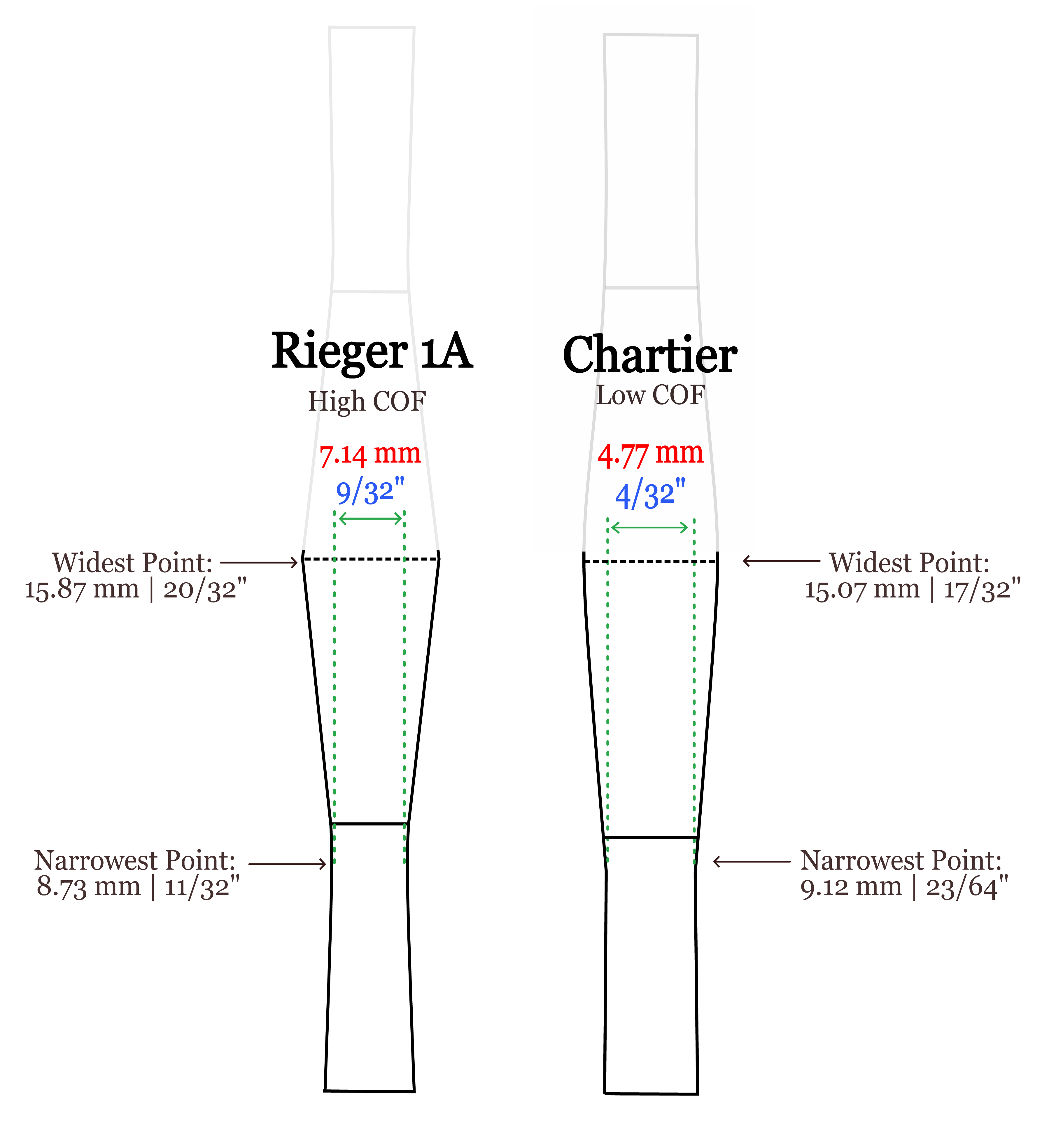
The Coefficient of Flare (or COF) is the difference between the shape’s widest and narrowest points. (3) The relationship between these two measurements will affect the size and shape of the reed’s tip opening, as well as the general response and ease of playability. (4)
In figure 1 (right) and on the diagrams below, the COF will be shown by the green lines/ arrows. The measurement is shown in milimeters in red and inches in blue.
Shape type
The shape of a bassoon reed refers to the lateral dimensions of the reed’s tube and blade. Different combinations of straight and curved lines are used to create specific shapes. Imagine a cookie cutter removing the excess dough to create a cookie in a particular shape. A cane shaper works in a similar way by removing excess cane to create a reed with a particular shape.
These days, there are many different shapes available for bassoon reeds, but they can generally be sorted into one of three categories (see figure 2, below). (1)
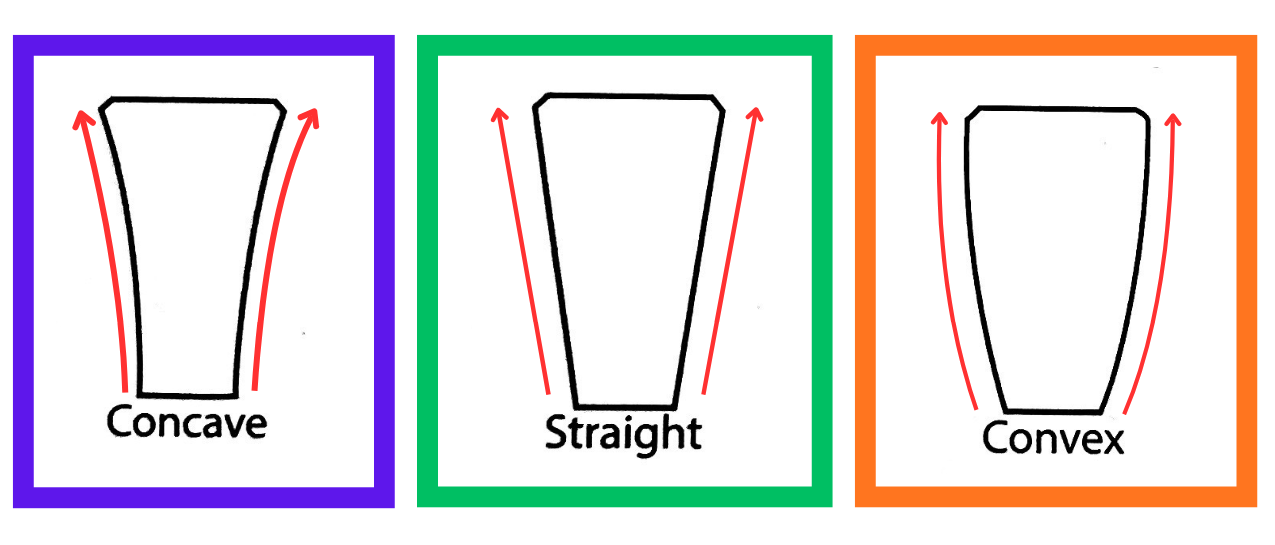
Concave: Also called a “flared” or “Knochenhauer” shape. This shape type is made from concave curves, creating a proportionally wider tip and narrower throat. Many concave shapes also have a slight flare at the bottom of the tube. Concave shapes tend to be narrower overall with less blowing resistance, a brighter sound, and higher pitch.
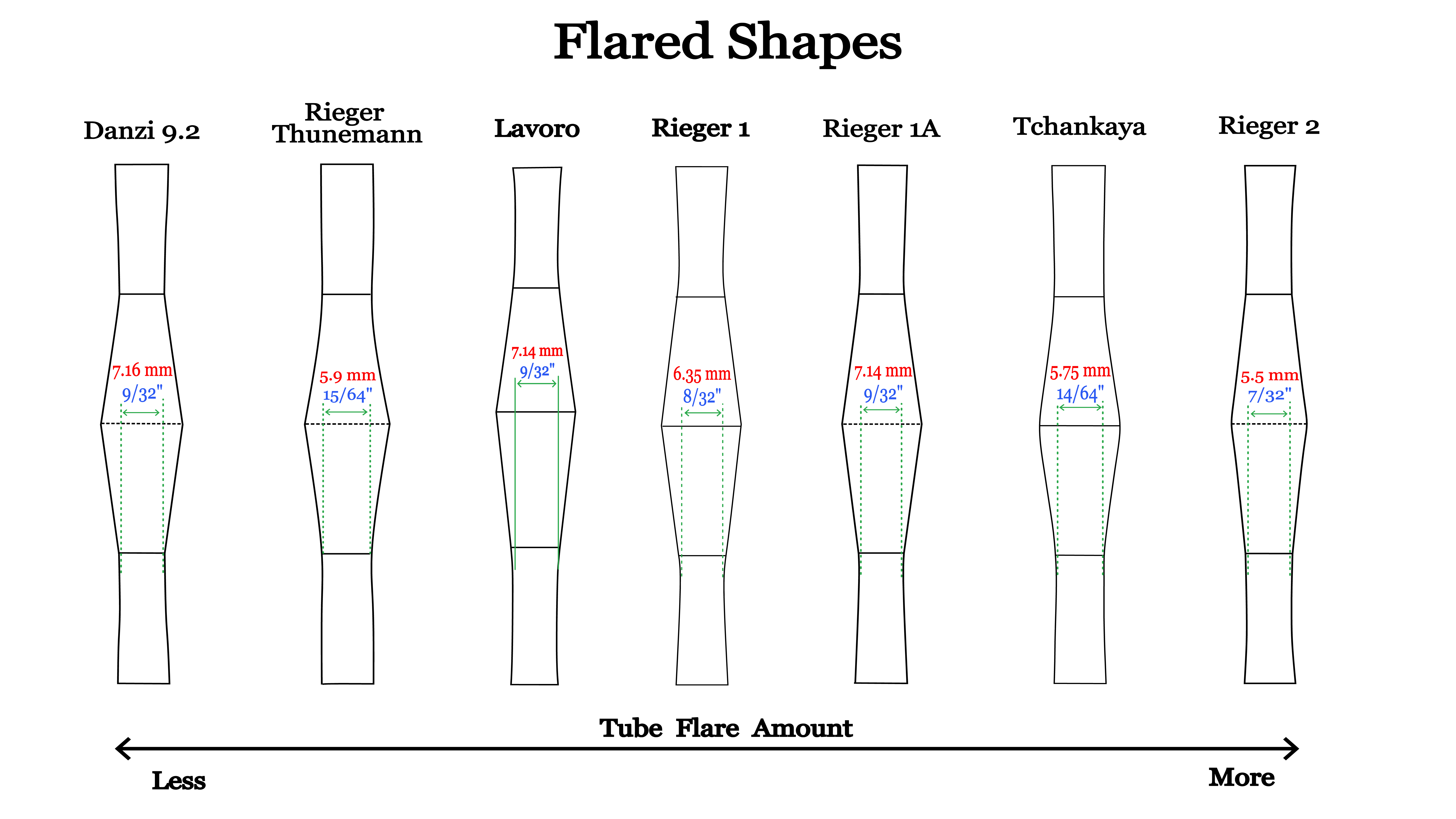
The flared shapes that we carry are: Danzi 9.2, Rieger Thunemann, Lavoro, Rieger #1, Rieger 1A, Tchankaya, and Rieger #2. See figure 2 for a comparison of these shapes.
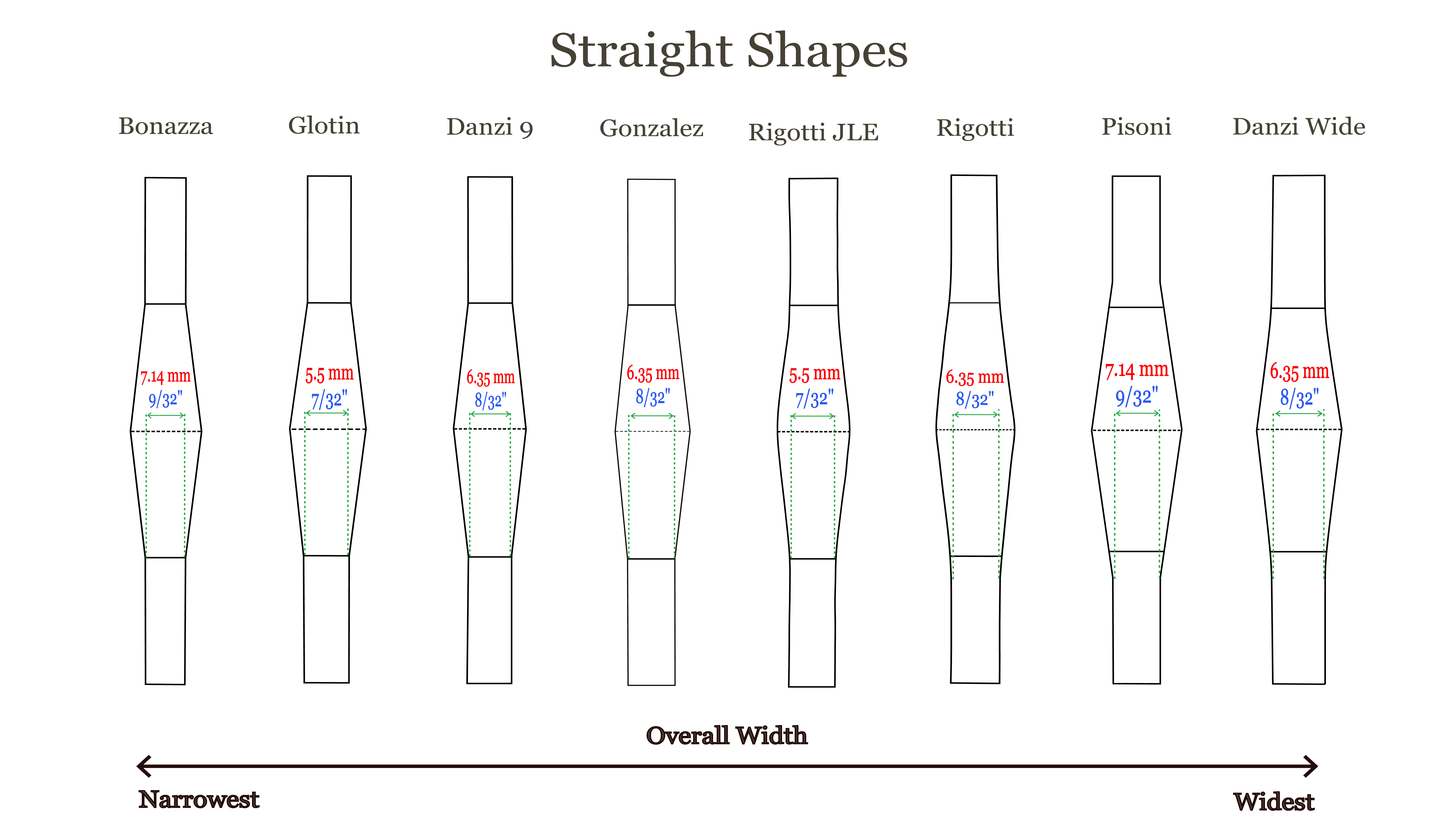
Straight: This shape is made of straight (or slightly curved) lines from collar to tip. These are a variation on the convex type, sometimes referred to as “almost Knochenhauer.” The tubes on straight shapes are also completely parallel up to or just before the collar. Straight shapes offer a happy medium in terms of tone and resistance between the convex and concave types. (2)
The straight shapes that we carry are: Bonazza, Danzi 9, Danzi Wide, Glotin, Gonzalez, Pisoni, Rigotti JLE, and Rigotti standard. A comparison of these shapes can be found in figure 4.
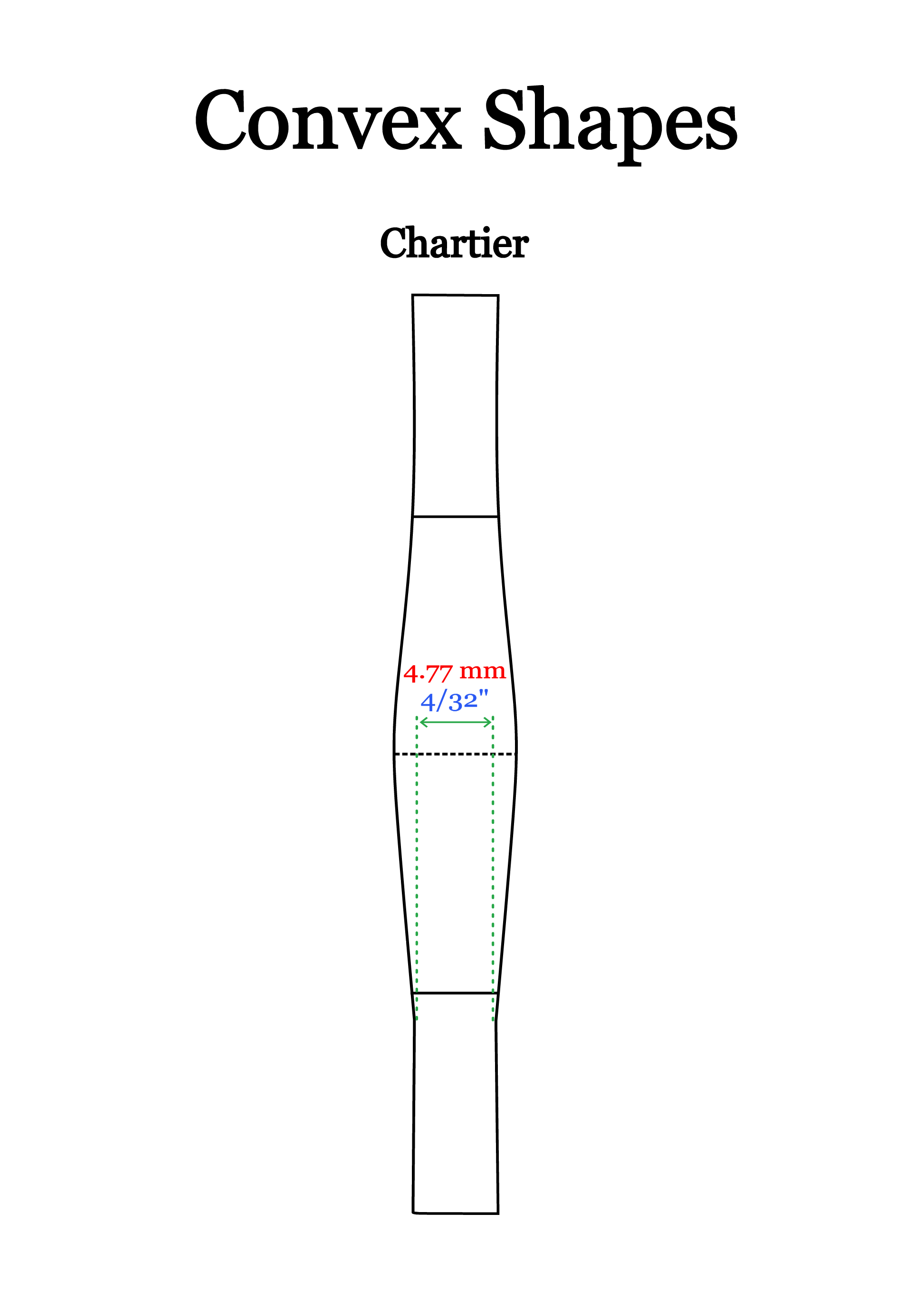
Convex: Also known as a “wine bottle” or “Mechler” shape. This shape type is made of convex curves, placing the widest part of the blade about halfway up the length. Concave shapes tend to have more blowing resistance, a darker sound, and flatter pitch. We currently carry one convex shape, shown in figure 5.
Profile types
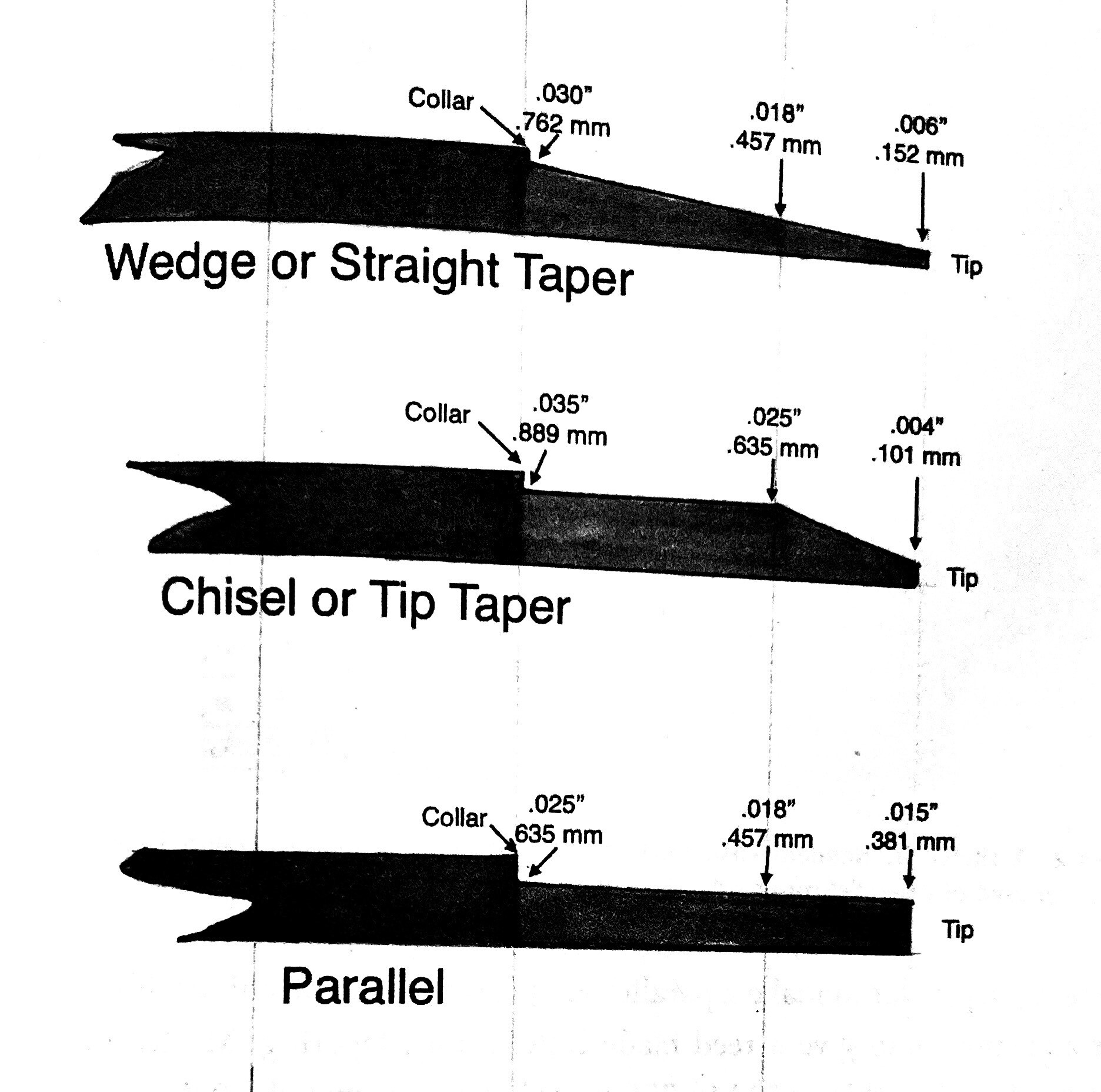
The profile of a bassoon reed refers to its “topographical map,”or the thickness of the blade at various points. In his book, Way of Cane, Eric Arbiter lists three basic profile types. (5) Diagrams of the three profile types are provided in figure 6. There are many variations among the three basic profile types. The measurements shown in figure 4 are examples of the proportions for that type of profile. The exact measurements will vary from brand to brand.
Wedge Taper: The profile tapers evenly from the collar to the tip. This is a steeper taper than the parallel profile.
Tip Taper: The profile tapers very slightly to a “critical point,” about ⅔ up the blade. It tapers more steeply from the critical point to the tip.
Parallel: The profile tapers very slightly from the collar to the tip. As a result, this type of profile is usually thinner in the back and heavier at the tip than the Wedge or Chisel types.
The diagram in figure 7 shows each brand of cane sorted by profile type.

Cane descriptions:
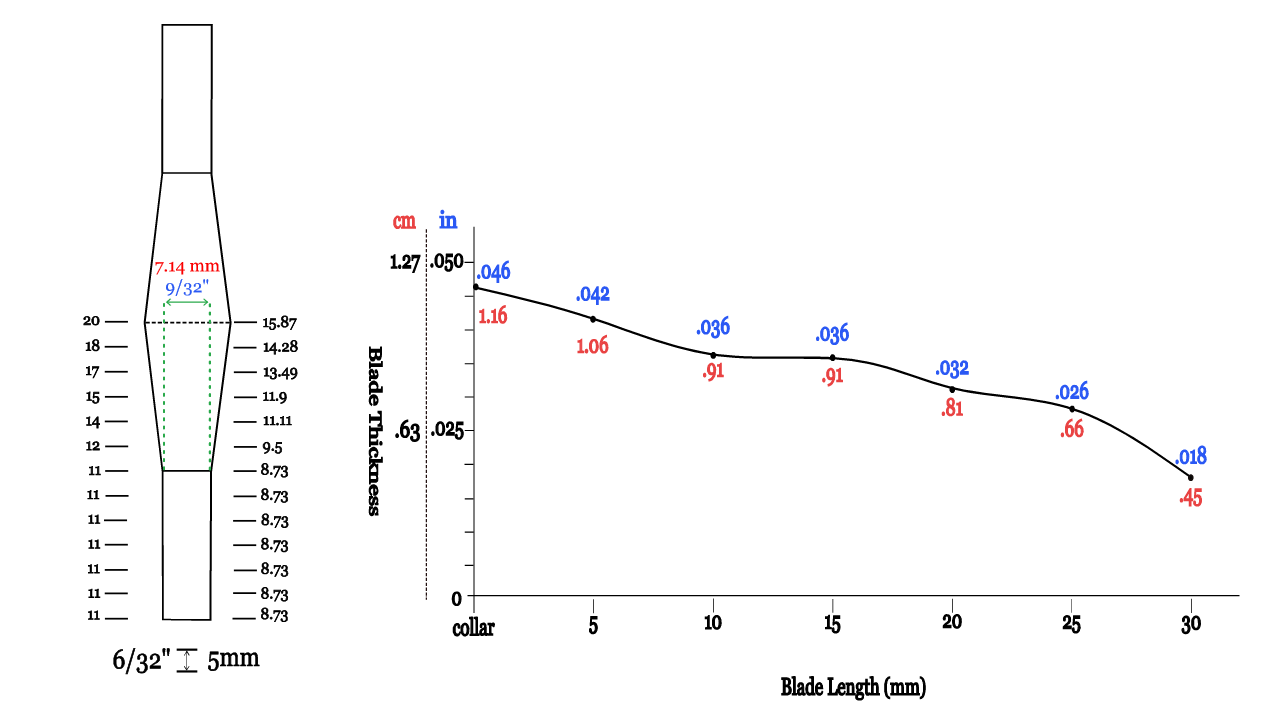
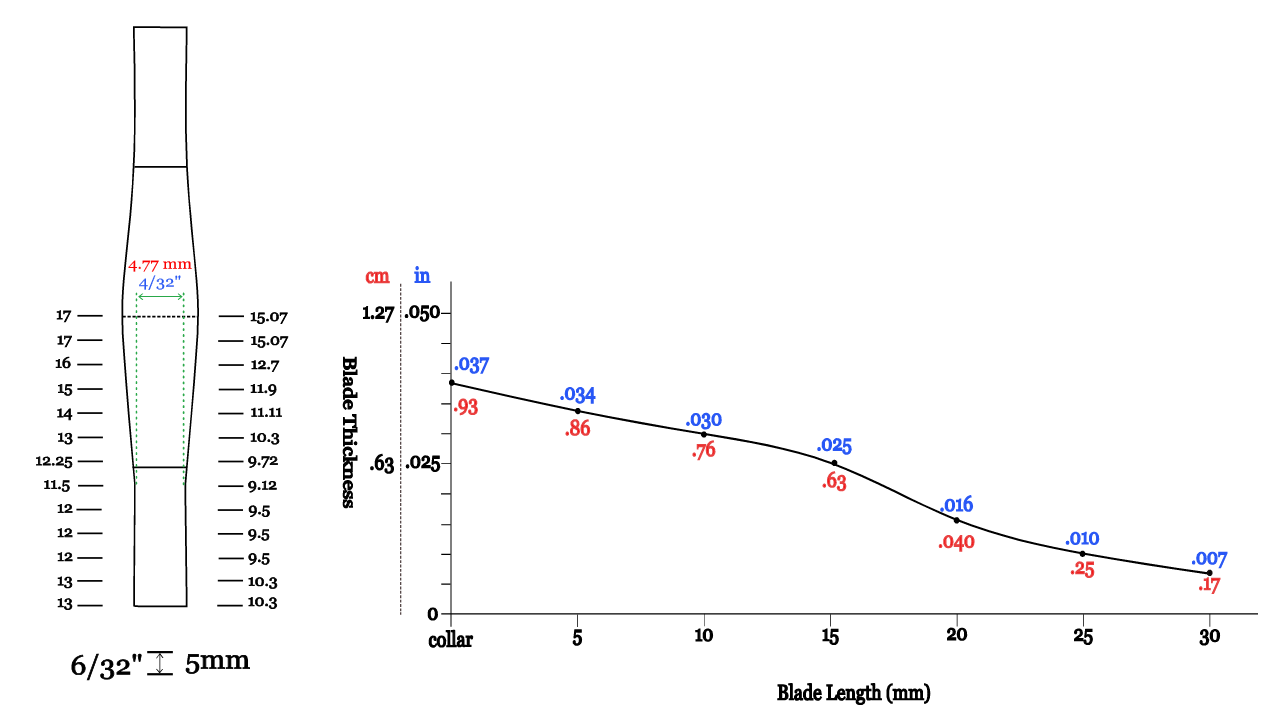
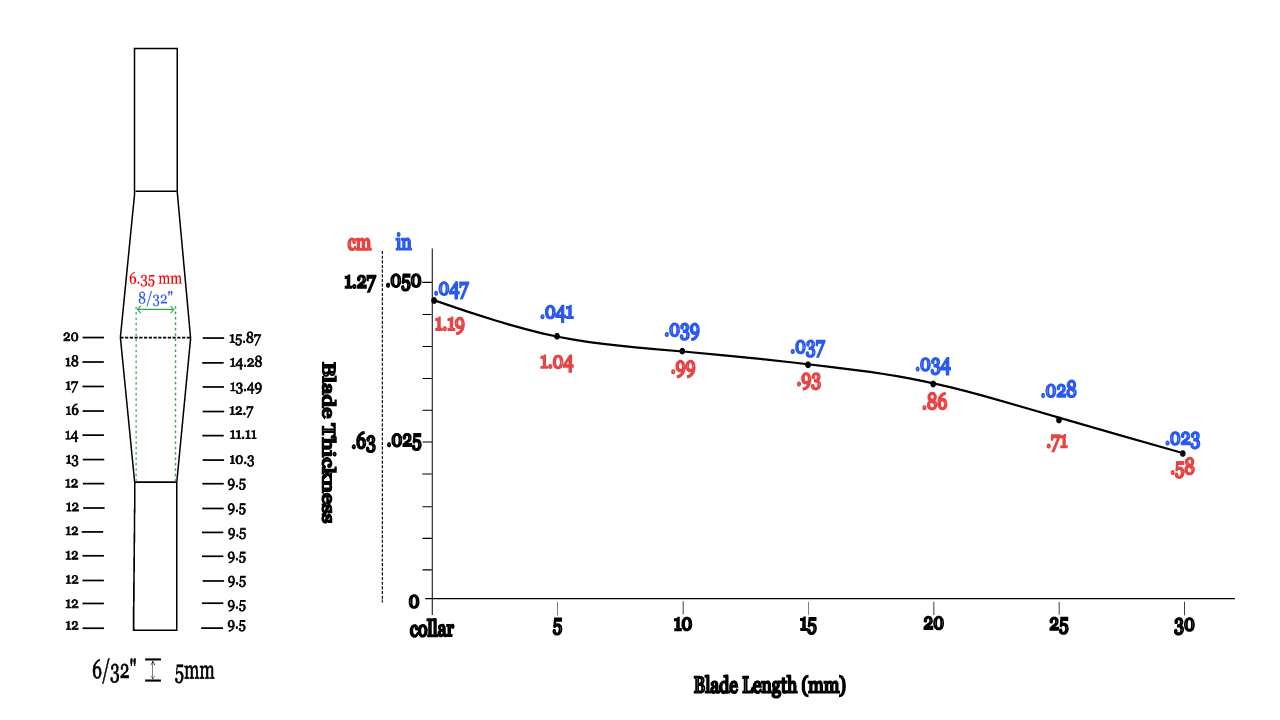
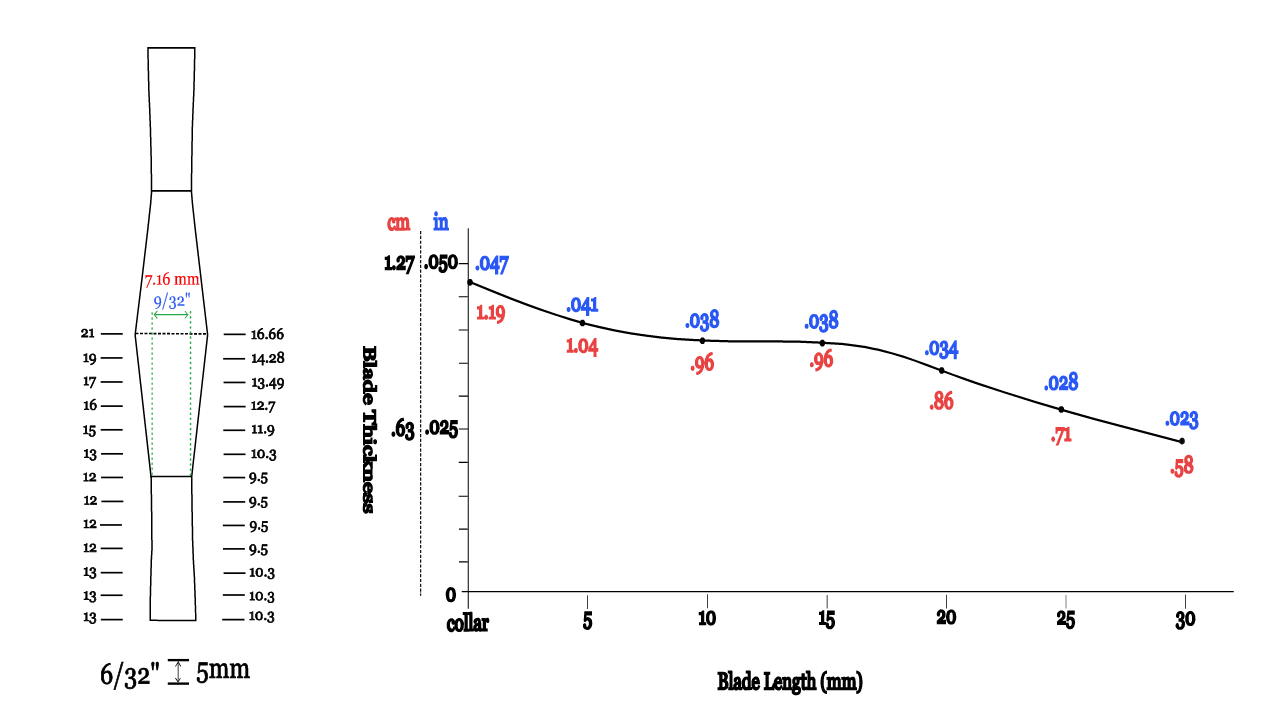
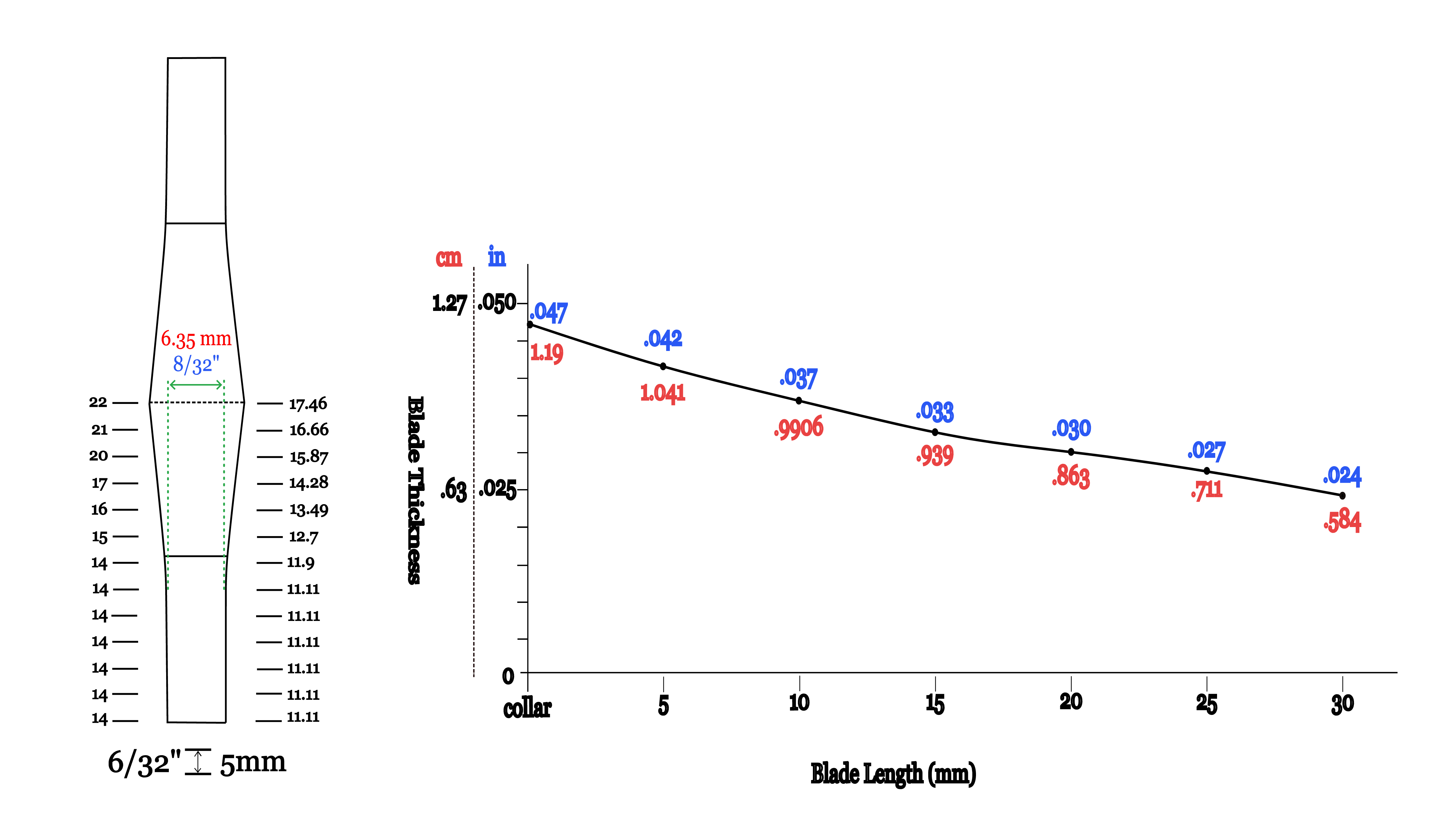
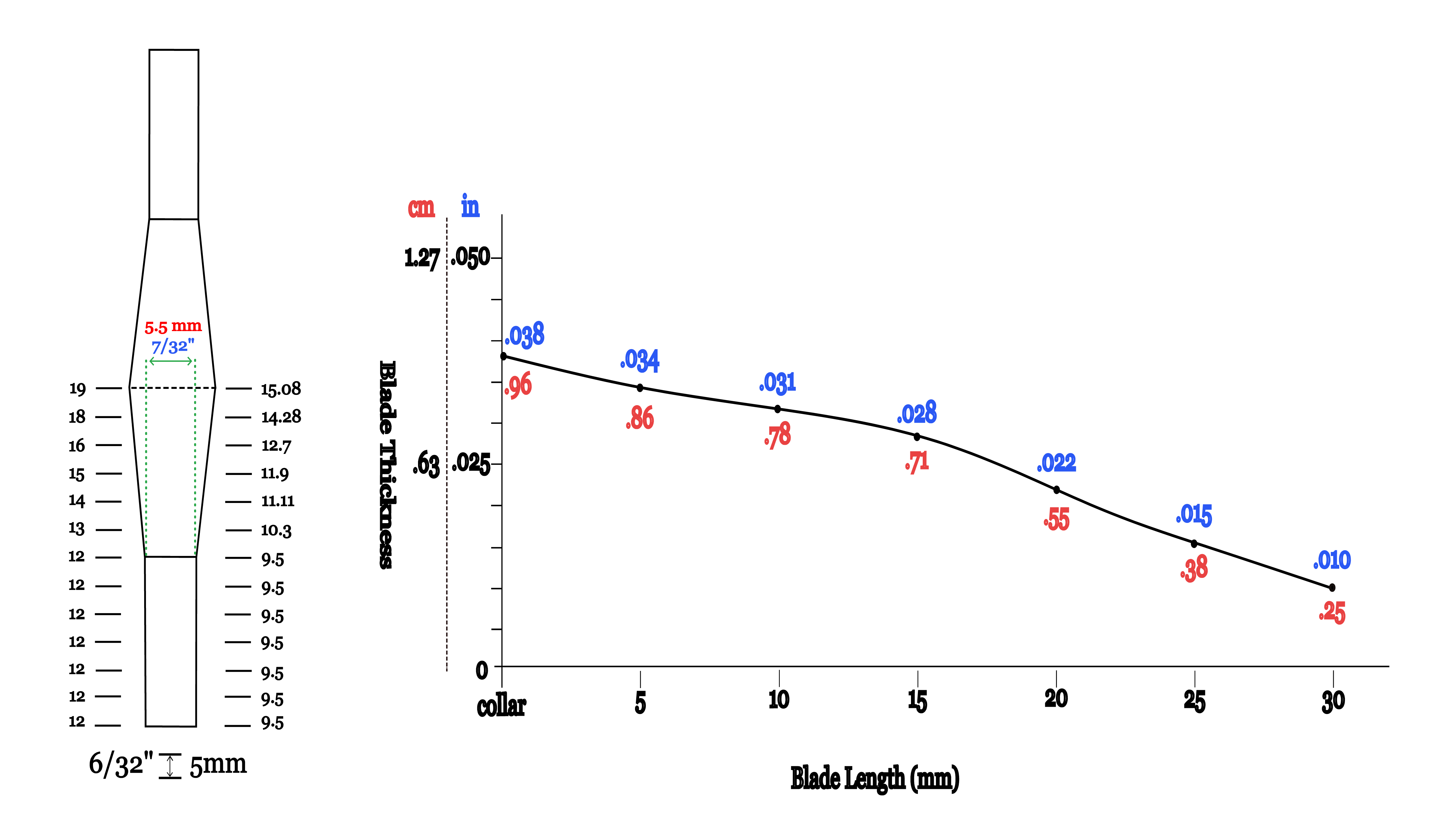
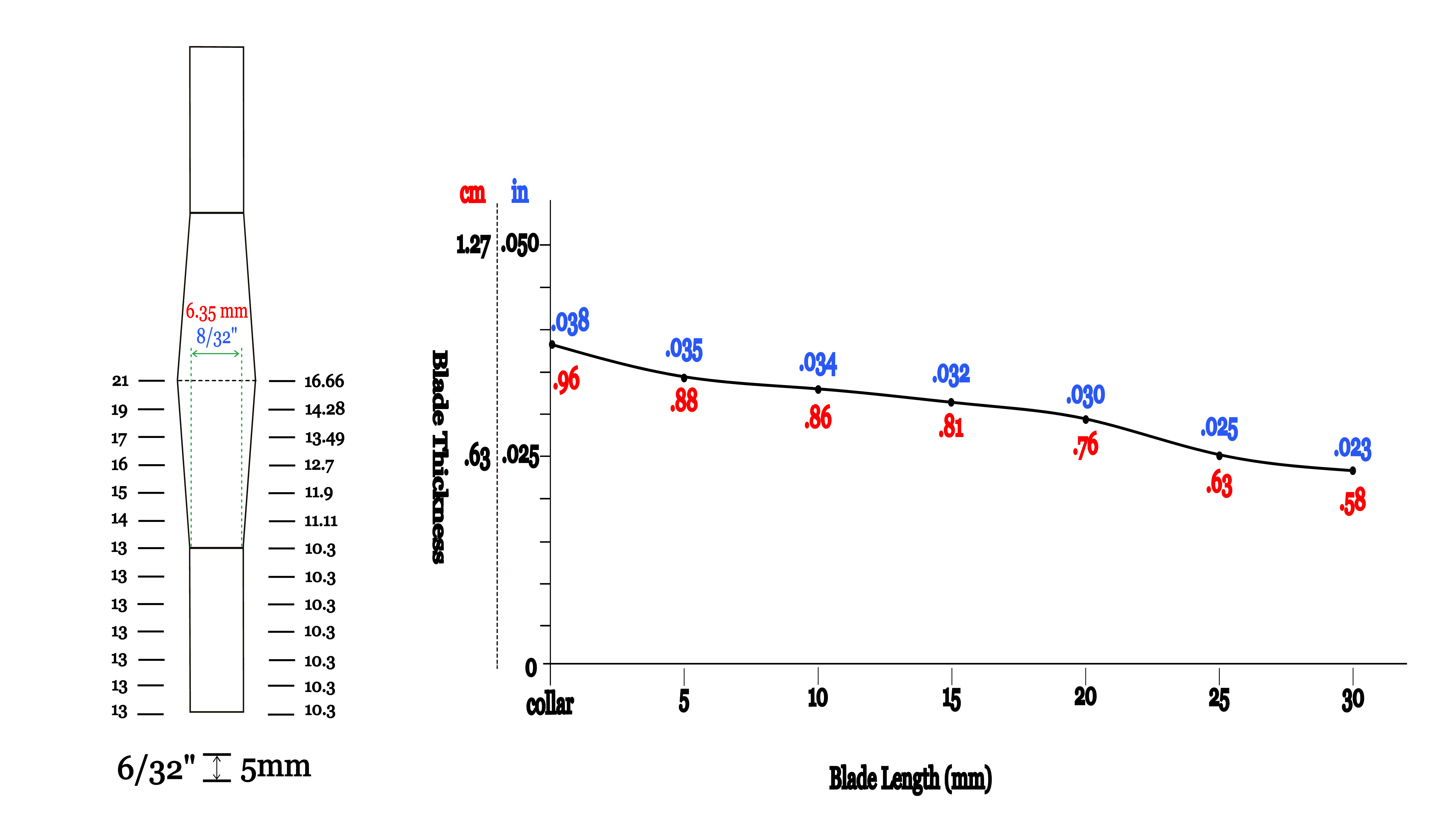
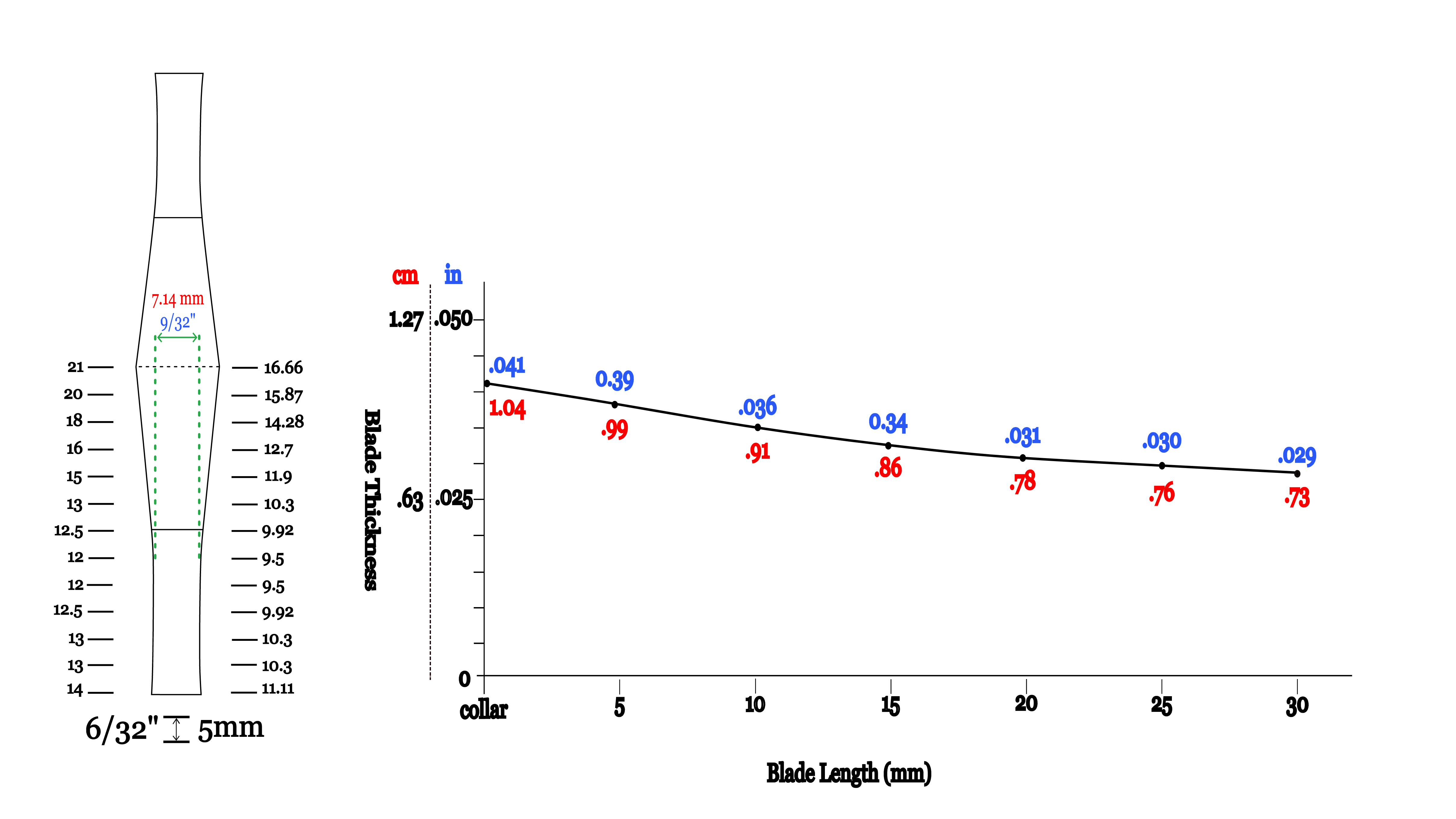
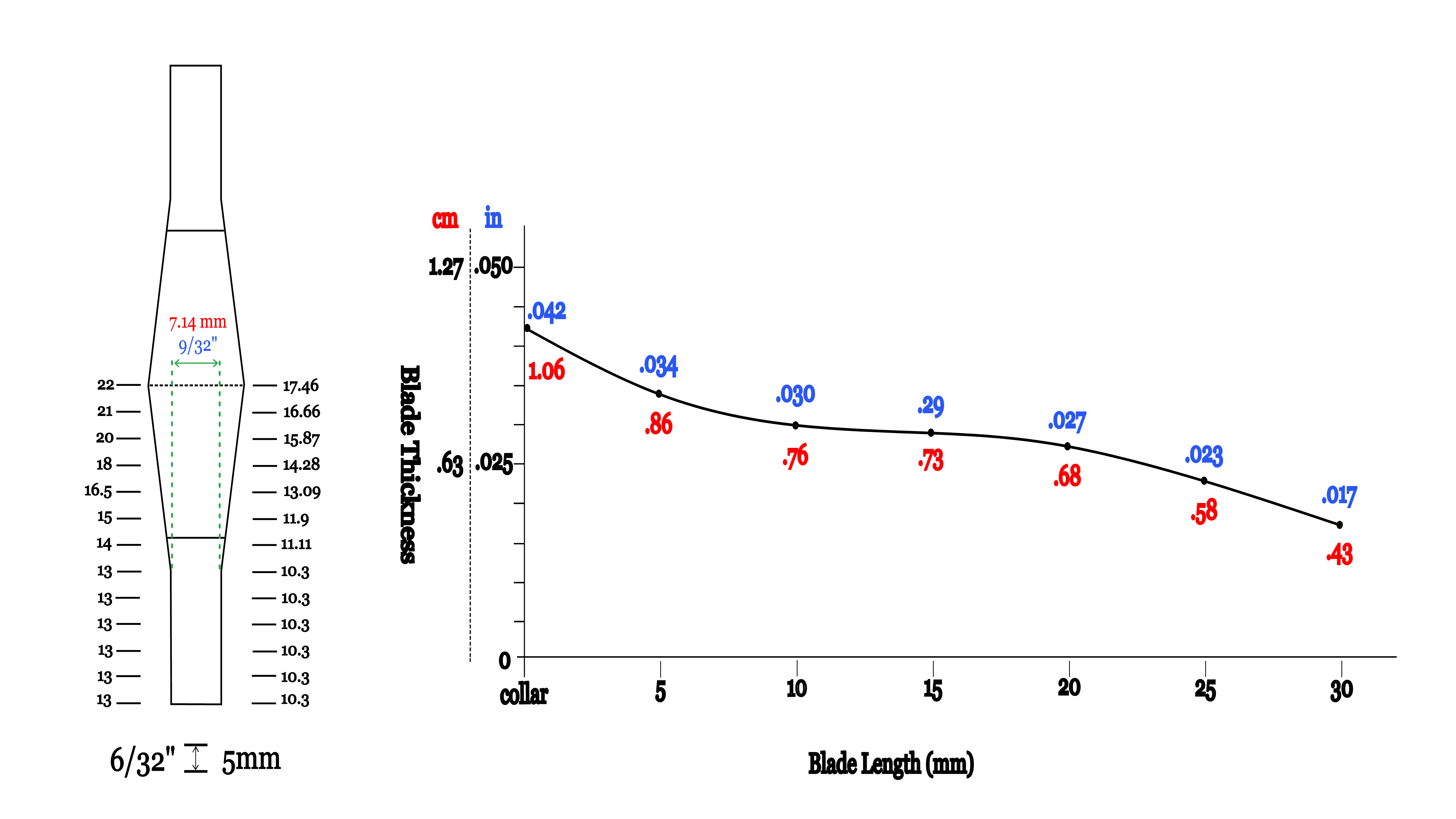
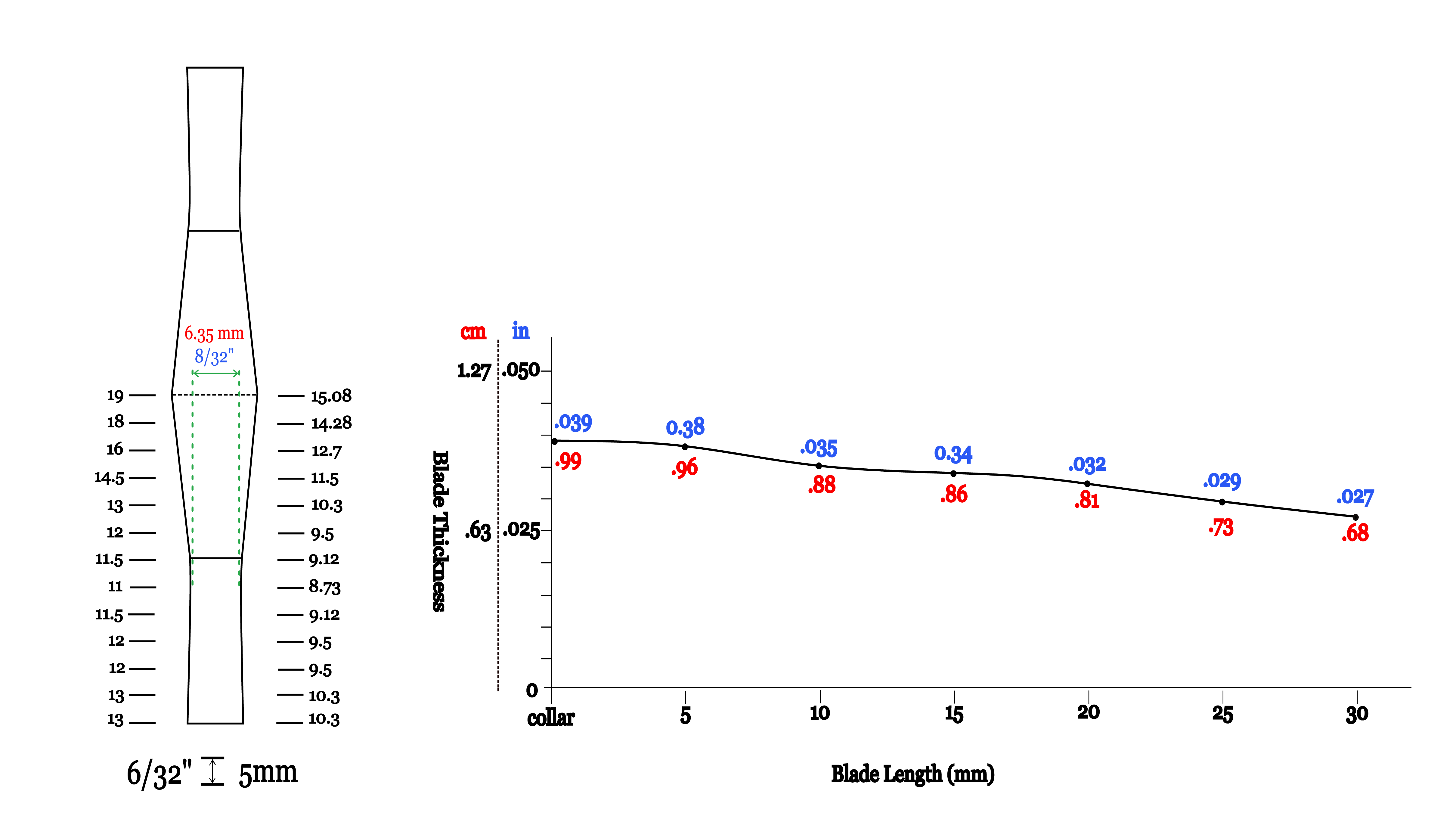
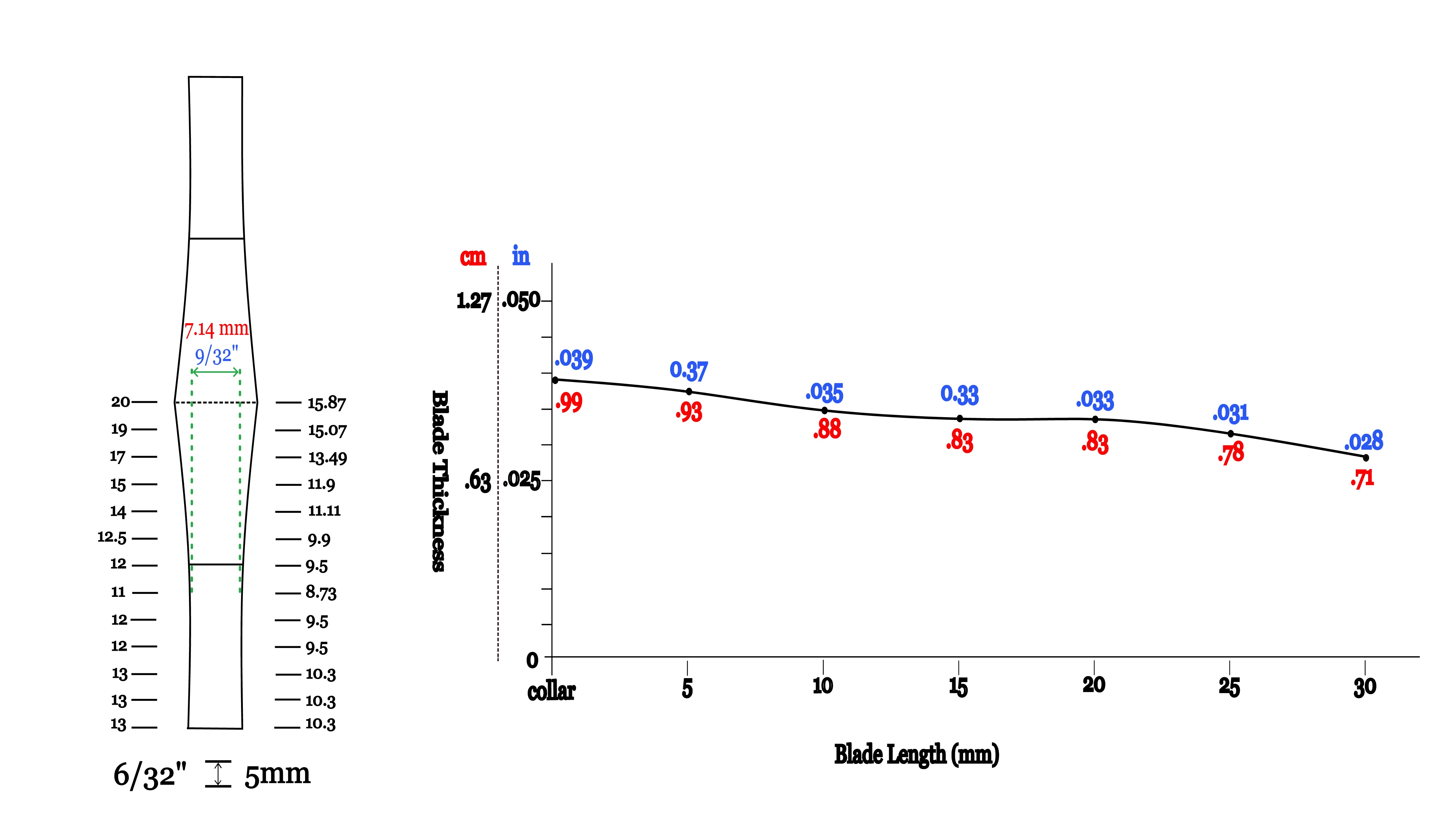
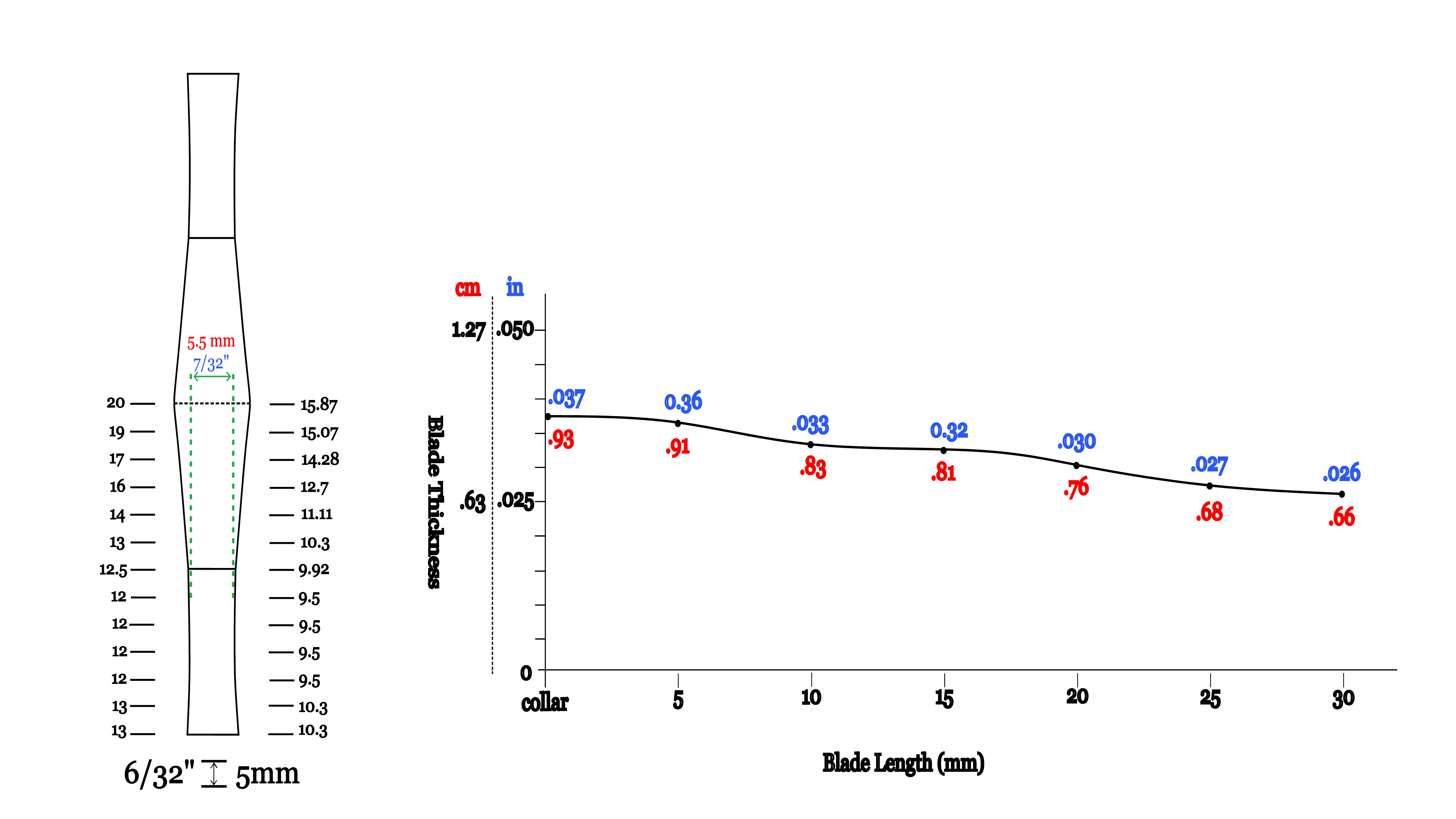
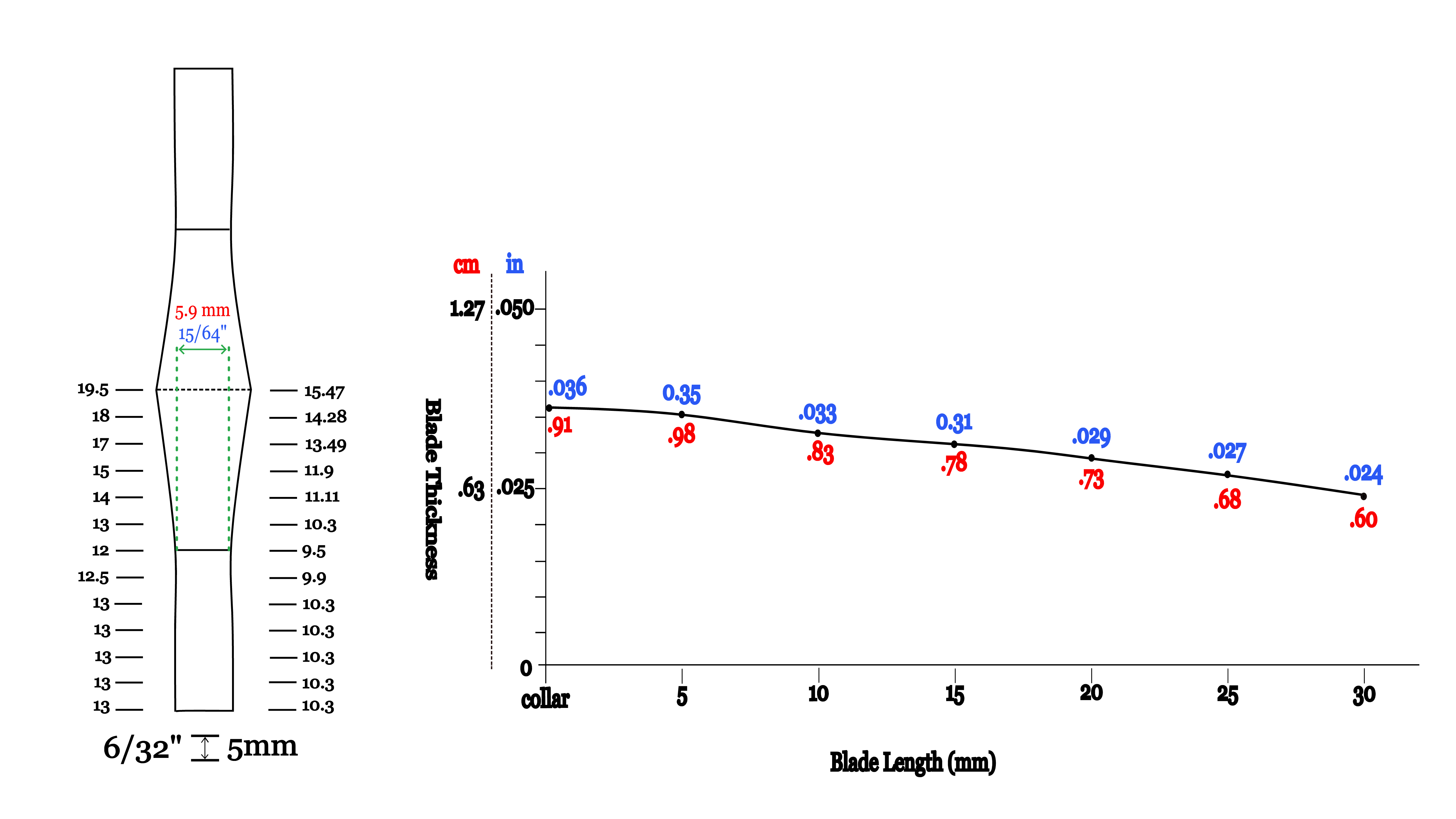
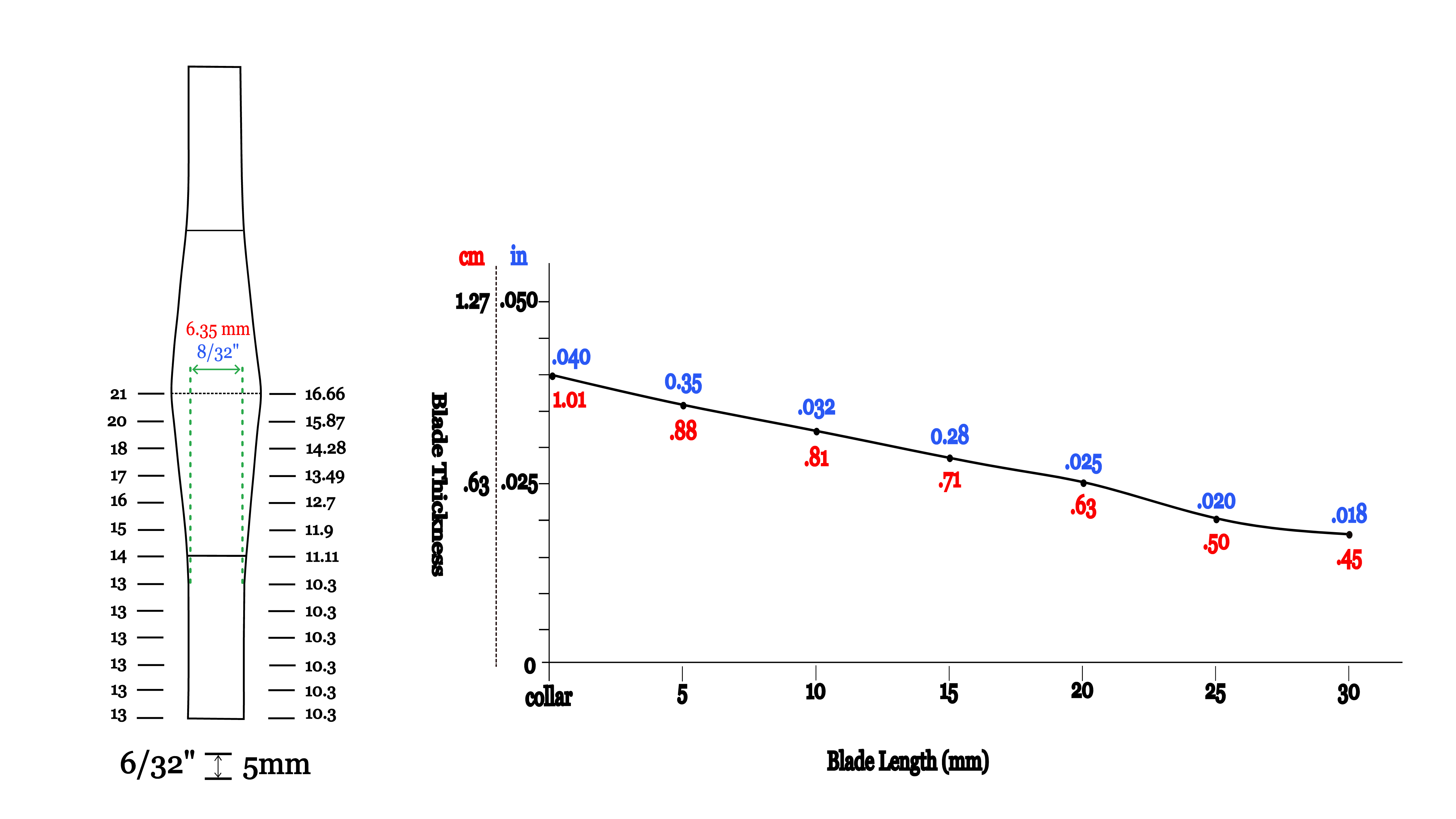
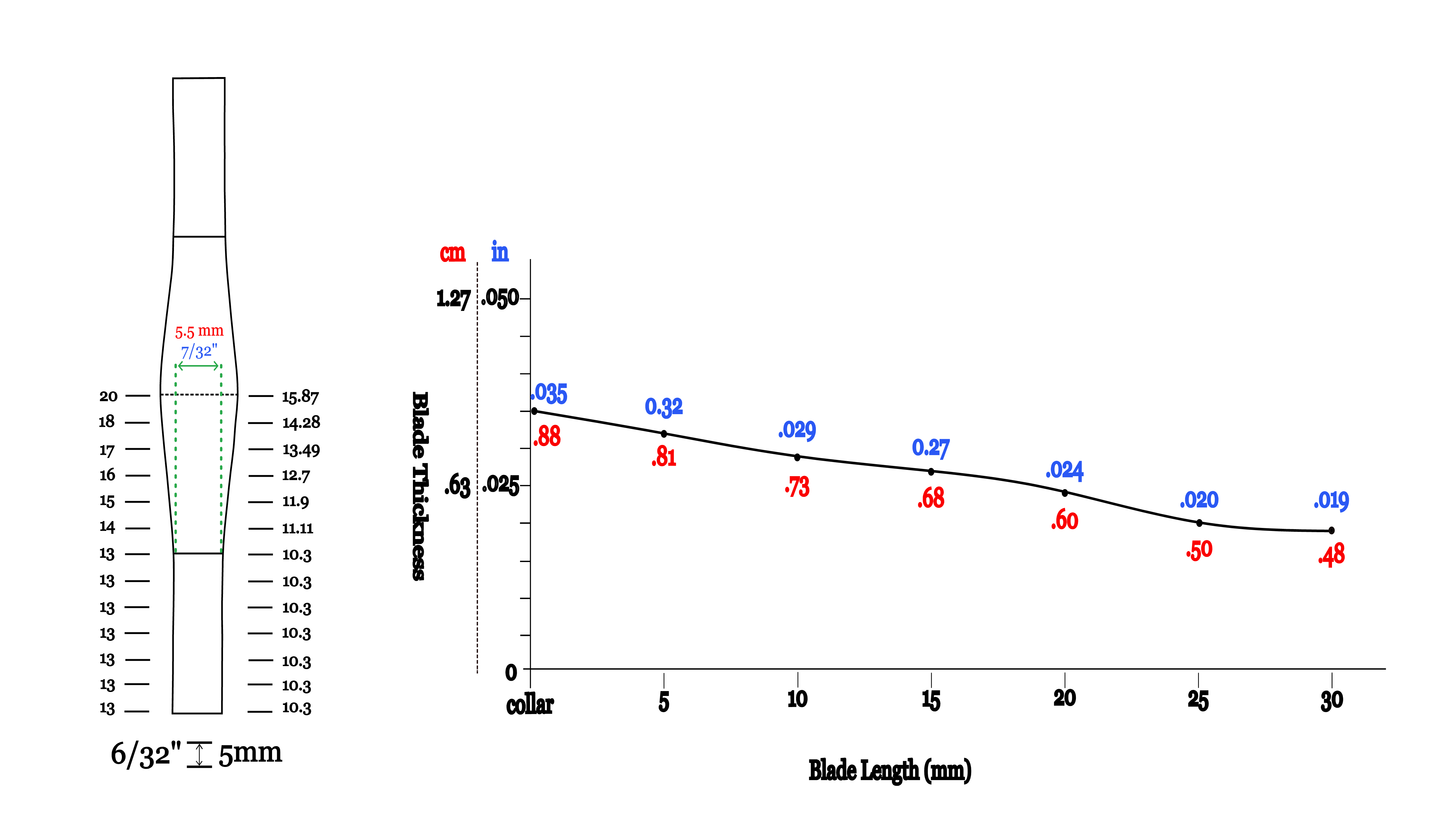
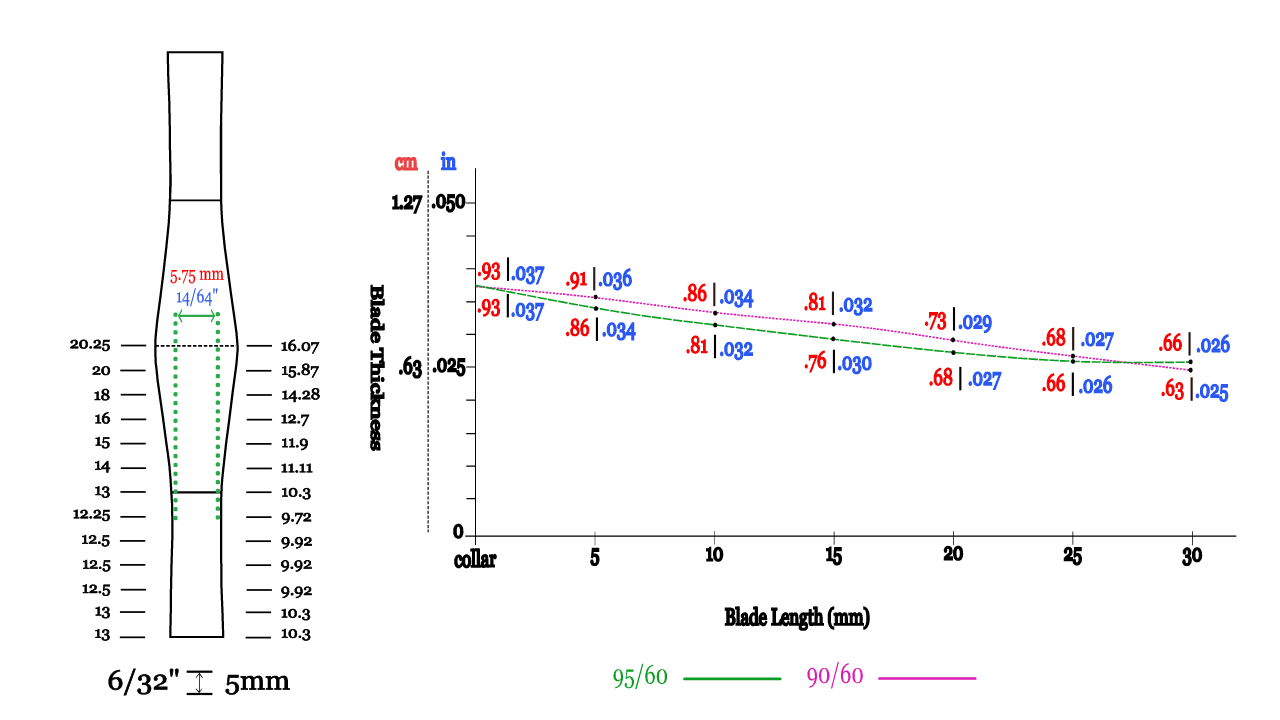
All of our GSP bassoon cane is 120mm (4.72") long. Note that the proportions of the blade and tube lengths can vary depending on the brand. The diagrams below indicate the width of each shape, measured every 5 mm (6/32"), as well as the profile measured in both .01 cm (red) and .0001 inches (blue). The tube and blade lengths, shape and profile types, and coefficient of flare are also listed.
Bonazza
Tube Length: 30 mm; 1 6/32" | Blade Length: 30 mm; 1 6/32"
Shape Type: Straight | Profile Type: Tip Taper | COF: 7.14mm; 9/32"
Chartier
Tube Length: 29mm; 1 5/32" | Blade Length: 31mm; 1 7/32"
Shape Type: Convex | Profile Type: Tip Taper | COF: 4.77 mm; 4/32"
Danzi 9
Tube Length: 30 mm; 1 6/32" | Blade Length: 30 mm; 1 6/32"
Shape Type: Straight | Profile Type: Tip Taper | COF: 6.35mm; 8/32"
Danzi 9.2
Tube Length: 30 mm; 1 6/32" | Blade Length: 30 mm; 1 6/32"
Shape Type: Flared | Profile Type: Tip Taper | COF: 7.14mm; 9/32"
Danzi Wide
Tube Length: 31mm; 1 7/32" | Blade Length: 29mm; 1 5/32"
Shape Type: Straight | Profile Type: Wedge | COF: 6.35mm; 8/32"
Glotin
Tube Length: 30 mm; 1 6/32" | Blade Length: 30 mm; 1 6/32"
Shape Type: Straight | Profile Type: Tip Taper | COF: 5.5mm; 7/32"
Gonzalez
Tube Length: 30 mm; 1 6/32" | Blade Length: 30 mm; 1 6/32"
Shape Type: Straight | Profile Type: Wedge | COF: 6.35mm; 8/32"
Lavoro
Tube Length: 30 mm; 1 6/32"| Blade Length: 30 mm; 1 6/32"
Shape Type: Flared | Profile Type: Parallel | COF:7.14mm; 9/32"
Pisoni
Tube Length: 31mm; 1 7/32" | Blade Length: 29mm 1 5/32"
Shape Type: Straight | Profile Type: Tip Taper | COF: 7.14mm; 9/32"
Rieger 1
Tube Length: 30 mm; 1 6/32" | Blade Length: 30 mm; 1 6/32"
Shape Type: Flared | Profile Type: Parallel | COF: 6.35mm; 8/32"
Rieger 1A
Tube Length: 30 mm; 1 6/32" | Blade Length: 30 mm; 1 6/32"
Shape Type: Flared | Profile Type: Parallel | COF: 7.14mm; 9/32"
Rieger 2
Tube Length: 30 mm; 1 6/32" | Blade Length: 30 mm; 1 6/32"
Shape Type: Flared | Profile Type: Parallel | COF: 5.5mm; 7/32"
Rieger Thunemann
Tube Length: 30 mm; 1 6/32" | Blade Length: 30 mm; 1 6/32"
Shape Type: Flared | Profile Type: Parallel | COF: 5.9mm; 15/64"
Rigotti Standard
Tube Length: 30 mm; 1 6/32" | Blade Length: 30 mm; 1 6/32"
Shape Type: Straight | Profile Type: Wedge | COF: 6.35mm; 8/32"
Rigotti JLE
Tube Length: 30 mm; 1 6/32" | Blade Length: 30 mm; 1 6/32"
Shape Type: Straight | Profile Type: Wedge | COF: 5.5mm; 7/32"
Tchankaya
Tube Length: 30 mm; 1 6/32" | Blade Length: 30 mm; 1 6/32"
Shape Type: Flared | Profile Type: Parallel | COF: 5.75mm; 14/64"
Conclusion
Choosing the right type of gsp cane can be daunting, but we’ve got a reed style to suit almost any setup and playing style. Our bassoon specialist, Dr. Clair Cangialosi is happy answer reed-related queries at clair@hodgeproductsinc.com
You can also contact us through our website. We're happy to help!
Works Cited
- Eubanks, Mark G. Quick Guide to Bassoon Reed Tuning. Enterprise, OR: Arundo Research Company, 2015. 3.
- Eubanks, Mark G. Quick Guide to Bassoon Reed Tuning. Enterprise, OR: Arundo Research Company, 2015. 3.
- Arbiter, Eric. Way of Cane. New York City, NY: Oxford University Press, 2020. 91.
- Kopp, James B. “Tube, Tip, and Aperture: The Functional Geometry of your Bassoon Reed.” The Double Reed 36, no. 3. 69-78.
- Arbiter, Eric. Way of Cane. New York City, NY: Oxford University Press, 2020. 105.