
A Brief History Of The Bassoon: Chapter 2, Tenoroon
Posted by Clair Cangialosi, DMA on Dec 29th 2025

The tenoroon as we know it today was developed by Guntram Wolf in 1992. This instrument is essentially a shrunken bassoon, pitched in F, G, or C (a perfect fourth, fifth or octave higher than the bassoon, respectively). These instruments are often used for starting young children on the bassoon, as seen in the following video.
However, the tenoroon also has roots in the late renaissance, and developed in a similar manner to the bassoon. This post will explore the history of the tenoroon.
Table of Contents
Early Music
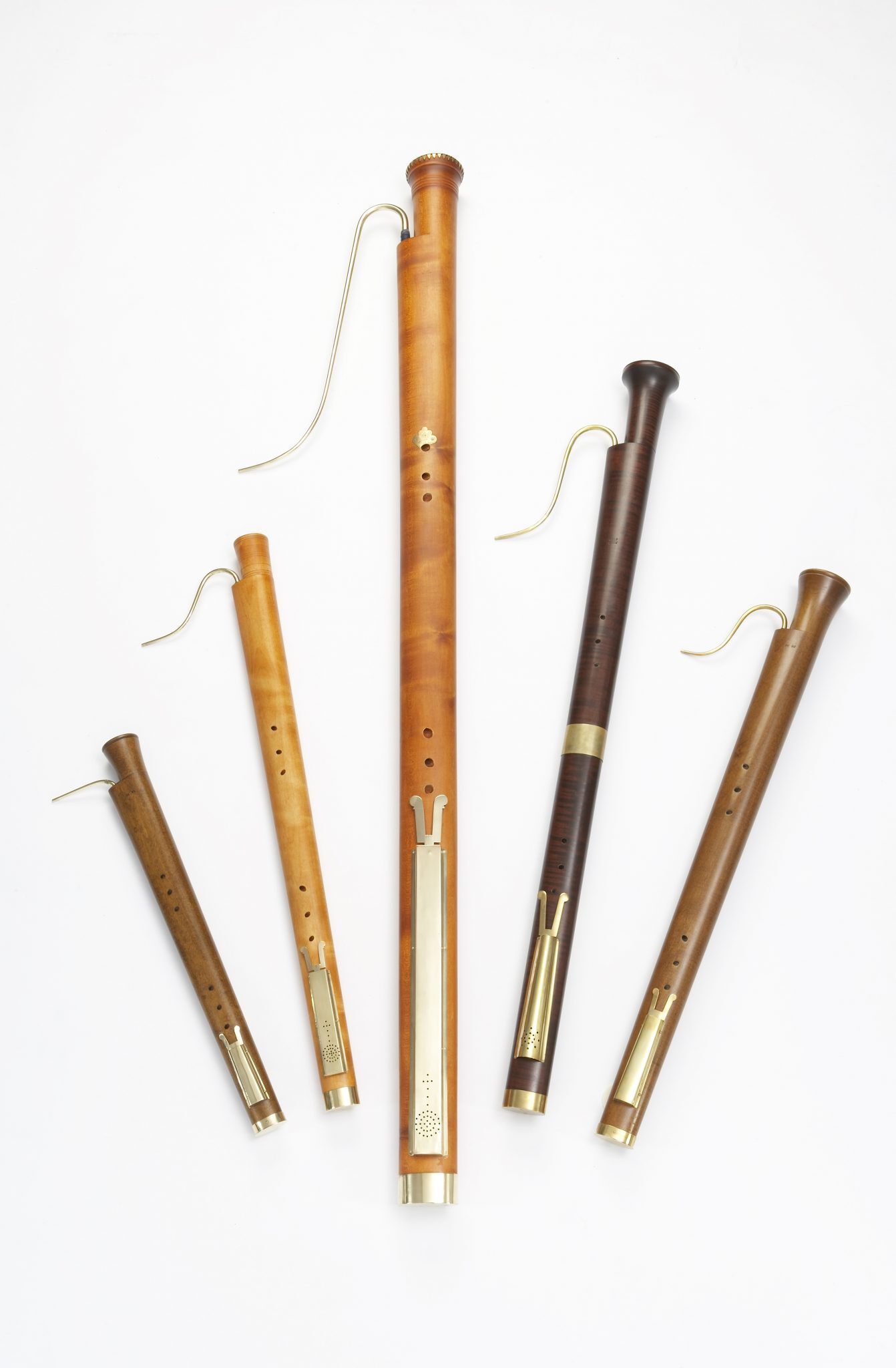
As we noted in chapter 1, the bassoon is the direct descendant of the dulcian, which was in use in the late renaissance and early baroque periods. In his 1620 treatise, Syntagma Musicum, music theorist Michael Praetorius describes several sizes of dulcians used in consort music. At this time, five-part harmonies were commonplace, so we can assume that a five-voice dulcian consort would be the norm. Figure 1 (right) shows the standard five voice dulcian consort comprised of a soprano, alto, two tenors, and a bass.
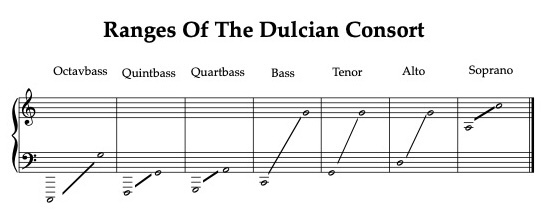
As we discussed in chapter 1, the bass dulcian (descending to C2) eventually evolved into the modern bassoon. Praetorius describes three smaller dulcians, the tenor (descending to G2), alto (descending to D3), and “diskant” or soprano (descending to A3). Praetorius also describes three sizes below the bass, Quartbassfagott (a fourth lower), Quintbassfagott (a fifth lower), and the rare Octavbassfagott, which will be discussed in detail in chapter three. Figure 2 below shows the approximate range of each member of the dulcian family.
Soprano Dulcian:
Recercada segunda sobre 'Doulce Memoire' from Trattado de Glosas (1553) by Diego Ortiz (c. 1517 - c. 1570)
Alto Dulcian:
"In syn treuren" composed by Georg Rhau (1542)
Tenor Dulcian:
"Magnificat Quia fecit'" composed by Cristóbal de Morales (1545)
The Common Practice Era
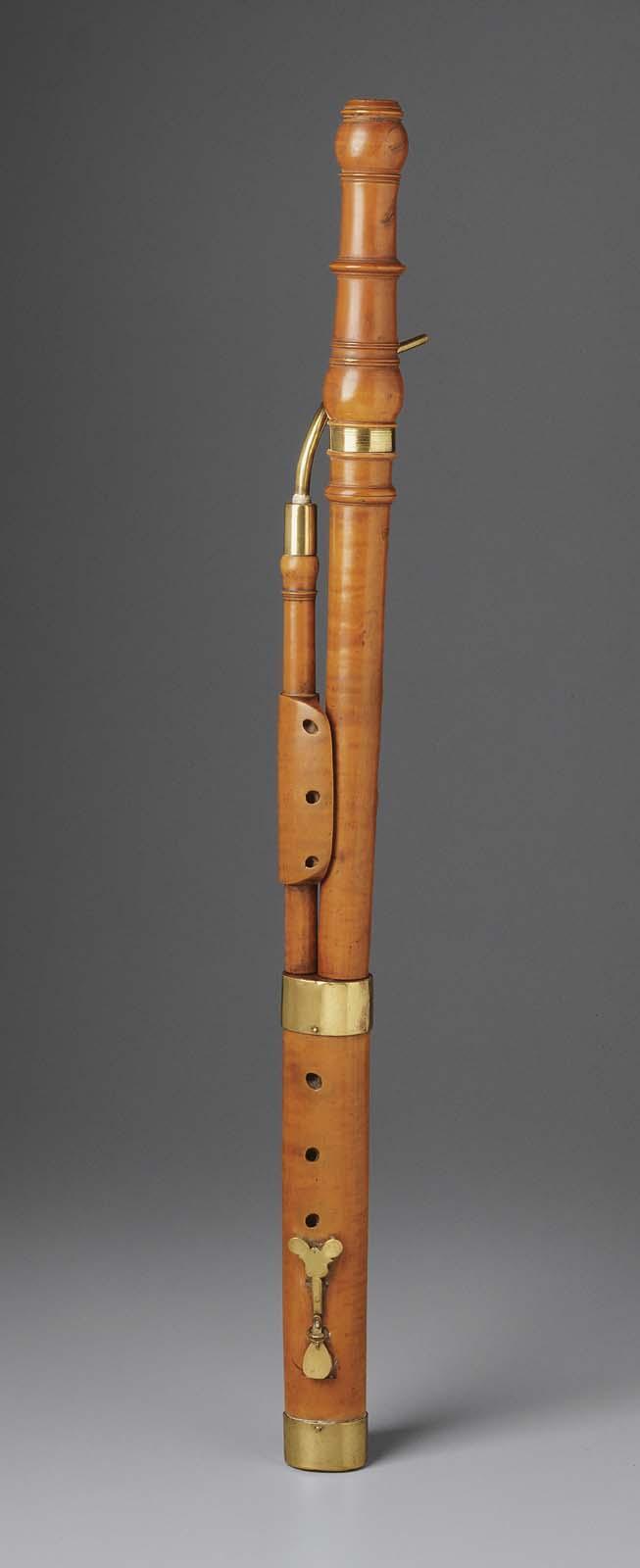
In the common practice era (1600-1900), the advent of the jointed bassoon also led to creation of two smaller bassoons, the tenoroon, pitched in F and the fagottino, pitched in C (an octave above bassoon). (2) Figure 2 (left), a fagottino made by J.C. Denner, made circa 1700 is on display at the Museum of Fine Art in Boston.
Music calling for smaller bassoons is rare, but recent work of The Fagottino Project indicates that the instruments did indeed survive into the nineteenth century as a performing instrument in its own right. James Kopp notes that in the 18th and 19th centuries, that smaller sized bassoons weren’t always specified in musical scores.The generic term “fagott” was understood to mean “the appropriate size of bassoon,” depending on the range of the piece in question. (3)
For example, in the video below of a performance of Georg Philipp Telemann's cantata, “Abscheuliche Tiefe des grossen Verderbens,” the bassoon part is noted in alto clef, and would not fit the range of the standard baroque bassoon. However, the part lies in a comfortable range for the fagottino.
One rare instance of an 18th century piece that specifically calls for smaller bassoons is Johann Georg Michael Frost’s Parthia IV for 2 octave bassoons, 2 tenoroons, 2 bassoons, and 2 horns in C. Frost was employed as a musician in the Dresden court, and his daughter was married to the prominent instrument maker, Heinrich Grenser. (3)
Modern Usage
By the late 19th century, the practice of using smaller bassoons seems to have faded from popularity, although Heckel continued to offer them until 1907 and Evette and Schaeffer (an English maker) until 1912. As noted above, the instrument lay mostly dormant until the 1990s. Since then, some professional bassoonists have advocated for the tenoroon and fagottino as performance instruments. Bassoonist and composer Victor Bruns (1904-1996) wrote two original pieces for “tenor bassoon,” his trio for Tenor bassoon, bassoon and contrabassoon, op.97, and his sonatina for tenor bassoon, op. 96. The latter also has a transposed version for bassoon, which is more often performed.
There are also a number of transcriptions of standard bassoon repertoire for tenoroon. In the following video, Richard Bobo (known for developing the subcontrabassoon) performs Four Sketches for Bassoon and Piano by Gordon Jacob. Bobo adapted the piece for tenoroon by transposing each movement into a higher key and adjusting the piano part accordingly.
Conclusion
Have you caught the tenoroon bug yet? If you’re itching to give this instrument a try, we’ve got you covered with tenoroon reeds from RM reeds!
As always, please feel free to contact us with any questions. We’re happy to help!
Go to Introduction
Go to Chapter 1
Go to Chapter 3
Works Cited
- Kopp, James B. The Bassoon. New Haven, Yale University Press, 2012. 22-23.
- Waterhouse, William. “Bassoon, 10. Other Sizes.” Grove Music Online, 2001. Accessed September 22, 2025.
- Kopp, James B. The Bassoon. New Haven, Yale University Press, 2012. 225.
- https://soundcloud.com/john-mcdougall1/jgm-frost-parthia-iv-for-2-octave-bassoons-2-tenoroons-2-bassoons-2-horns-ca1786