
A Brief History Of The Bassoon: Chapter 1, The Early Bassoons
Posted by Clair Cangialosi, DMA on Dec 15th 2025
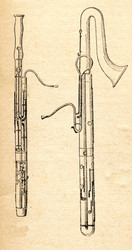
The introduction of this series described the development of early woodwind instruments during the renaissance, ending with the bassoon’s most direct ancestor, the dulcian. This chapter will provide a closer look at the instrument makers, performers, pedagogues, and repertoire which shaped the instrument’s history from its inception in the 17th century to the creation of the Heckel system in the 19th century. Although bassoons were eventually being produced by makers all over Europe, we will focus on those in France and the German States.
Table of contents
The Baroque Bassoon
It is not clear exactly when or where the baroque bassoon was first invented, although some sources credit French instrument maker Nicholas Hotteterre with producing it around 1685 for the court orchestra of King Louis XIV. The dulcian and baroque bassoon existed side by side for many years before the latter eventually reigned superior. Hotteterre’s new instrument was made with four joints and had three keys for low F, low D and low B-flat.The separated joints allowed each section of the instrument to be tuned individually. As the French musical style began to spread, Hotteterre’s design was copied and distributed by instrument makers in other areas of Europe. J.C. Denner (1655-1707) of Nuremberg, who had previously been known for building dulcians, began producing bassoons in 1696 (see figure 1, right). (1)

At first, the Baroque bassoon was primarily used as a bass instrument, doubling the low strings or playing continuo parts in chamber music. However, as early as the turn of the 18th century, composers had begun to push the bassoon into the tenor register. French opera composer, Jean- Philippe Rameau (1683-1764), wrote numerous exposed obligato parts for bassoon, perhaps foreshadowing the different roles of the bassoon which would evolve in the classical era. One example is an aria, Lieux Funestes from his 1744 opera, Dardanus. (3)

Developments to this instrument over the next century were gradual. Eventually, two more keys were added for G-sharp and low E-flat. (figure 2, left) (2) There are two (of many) German instrument makers,whose instruments bridge between the baroque and classical styles: Carl Augustin Grenser (1720-1807) of Dresden, and Johann Heinrich Eichentopf (1678-1769) of Leipzig. Grenser began making and selling instruments in Dresden in 1744, and was appointed as the official instrument maker for the wealthy Saxon court in 1753. By 1756, the Dresden court orchestra employed six bassoonists! (3) Eichentopf was working in nearby Leipzig when J.S. Bach became Kapellmeister there in 1723. His surviving instruments are the most often used for models of modern reproductions. (4)
Baroque Era Repertoire of Note:
- Georg Philip Telemann, Sonata in F Minor, 1728
- Johann Ersnt Galliard, Six Sonatas, 1733
- Antonio Vivaldi, Concerto for Bassoon and Strings, in G minor RV 495
The Classical Bassoon
In the second half of the 18th century is when the bassoon started to resemble the modern instrument we have today. Several key factors spurred on the development of the bassoon during this period: rising orchestral pitch levels, and the increased use of woodwinds as solo instruments within the orchestra, increasing harmonic complexity in orchestral repertoire, and a need for a more powerful sound. (5) In addition to playing basslines, the bassoon was now often used to double the upper woodwinds, violin, and voice in unison or octaves. This required more technical facility and projection in the upper register, which was facilitated by redesigning the bore to be longer and with thinner walls than the baroque bassoon. An example of this type of scoring is found in Mozart’s 1788 Symphony no. 41 “Jupiter.”
There is a notable difference in sound quality between the baroque and classical bassoons. The new classical bassoons had more high overtones in the sound spectrum, resulting in a brighter, more penetrating sound. (6) Despite these innovations, many chromatic notes could only be produced via forked fingerings, resulting in uneven tone, volume, and intonation. To combat this, bassoon-specific pedagogy materials began to emerge in the late 18th century. Players had to learn to adjust for pitch with their embouchure, similarly (although to a greater extent) to what we still do on modern bassoon. Books such as Etienne Ozi’s 1787 Nouvelle Méthode de Basson, advise bassoonists to “imitate the beautiful human voice.” (7) This demonstrates that despite the instrument’s mechanical shortcomings, performers were still striving for a sound quality that was even, full, and resonant throughout its range.
The addition of extra keys was still relatively slow. Shortly after Heinrich Grenser (1764-1813) inherited the Dresden-based instrument firm from his uncle in 1796, he made a radical move: shifting the low E-flat key from the back of the instrument (operated by the left thumb) to the front (operated by the left pinky). This marked the first major departure between the French and German style instruments. Figure three (right) shows a reproduction classical bassoon with eight keys- low F, G-sharp, low E-flat, low D, low C, and high A and C speaker keys on the wing joint.

Classical Era Repertoire of Note:
- Concerto in B-flat Major for Bassoon, K. 191, W.A. Mozart, 1774
- Six Sonatas for Bassoon and Continuo, op. 24, François Devienne
- Franz Danzi, Wind Quintet op. 56, no. 1
The Romantic Bassoon
During the nineteenth century, the bassoon underwent several dramatic changes, eventually resulting in the instrument we know and love today. The Romantic era was a period of rapid scientific discovery and technological innovation thanks to international trade exhibitions and the mass production of musical instruments.
One such important discovery was of the longitudinal vibration of the air column found inside musical instruments as the source of sound, first described by “the father of acoustics,” Friedrich Chladni in 1802. This idea was expanded upon by music theorist and conductor, Gottfried Weber in 1815. He proposed that the bassoon’s uneven scale could be remedied by moving certain toneholes to acoustically optimal positions along the length of the bore and adjusting the size of the toneholes accordingly. This idea caught the attention of Weber’s colleague, bassoonist Carl Almenräder (1786-1843).(8) This principle also led to the invention of the saxophone and several other instruments.
In 1823, Almenräder published his Treatise on the Improvement of the Bassoon, listing several proposed changes to H. Grenser’s "Dresden Bassoon," which was considered the industry standard at the time. Almenräder’s design featured adjustments to the bore and tonehole proportions for several notes to improve resonance and intonation. He also added keys for low B, low C-sharp, and alternate G-sharp and B-flat keys (for the right thumb and right 3rd finger, respectively), which improved facility and eliminated the need for most chromatic forked fingerings. (9)
Almenräder’s work was further expanded upon by Johan Adam Heckel, founder of the Heckel company (the two worked together briefly from 1829-1838). Many etude and method books which are widely used today were written as a response to these new developments. In 1877, Johann Adam’s son, Wilhelm Heckel took over the company. His continued developments resulted in what is known today as the Heckel System. By the turn of the twentieth century, Wilhelm’s design had become the archetype of the German-system bassoon.
Romantic Era Repertoire of Note:
- Concerto for Bassoon in F Major, op. 75, Carl Maria von Weber
- Bassoon Concertino, op. 12, Ferdinand David
- Bassoon Konzertstük, op. 2, Franz Berwald
Conclusion
Although the bassoon has changed dramatically in its three-hundred year history, the essentials that make the bassoon unique- the shape of the bore and toneholes- have persisted to preserve its beguiling sound. This post is just a snippet of the large and varied repertoire available for the bassoon.
Interested in playing historical bassoon? We stock processed cane, shapers, and tip profile templates for baroque bassoon!
Go to Introduction
Go to Chapter 2
Go to Chapter 3
Works Cited
- Waterhouse, William. “Bassoon, 3. The Early Bassoon.” Grove Music Online, 2001. Accessed September 22, 2025. https://doi-org.suproxy.idm.oclc.org/10.1093/gmo/9781561592630.article.02276
- Waterhouse, William. “Bassoon, 3. The Early Bassoon.” Grove Music Online, 2001. Accessed September 22, 2025. https://doi-org.suproxy.idm.oclc.org/10.1093/gmo/9781561592630.article.02276
- Kopp, James B. The Bassoon. New Haven, Yale University Press, 2012. 76.
- Rachor, David. Eichentopf, Johann Bassoons. Accessed September 25th, 2025. https://davidrachor.com/eichentopf-johann-bassoons/
- Kopp, James B. The Bassoon. New Haven, Yale University Press, 2012. 86.
- Kopp, James B. The Bassoon. New Haven, Yale University Press, 2012. 87.
- Kopp, James B. The Bassoon. New Haven, Yale University Press, 2012. 91
- Kopp, James B. The Bassoon. New Haven, Yale University Press, 2012. 115-116
- Kopp, James B. The Bassoon. New Haven, Yale University Press, 2012. 117