
Book Review: Quick Guide To Bassoon Reed Tuning
Posted by Clair Cangialosi, DMA on Nov 2nd 2026
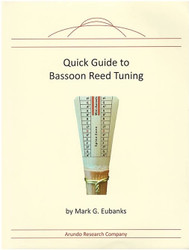
Quick Guide To Bassoon Reed Tuning by Mark G. Eubanks is an adjustment method for tuning bassoon reeds. Eubanks presents play tests and correlating solutions for each note on the bassoon, which aid in evaluating and scraping a bassoon reed for one’s unique musical needs. The basis of the method is what Eubanks describes as “the three R’s”: response, resistance, and resonance. These aspects are considered in conjunction with the reed’s design and construction when making adjustments throughout the book. Quick Guide To Bassoon Reed Tuning is published by Arundo Research Company.
About the Author
Mark Eubanks is a bassoonist, educator, reedmaker, and researcher, currently based in Washington State. He is currently the principal bassoon of the Walla Walla Symphony Orchestra, having previously held positions in the Tacoma Symphony, Seattle Symphony and Seattle Opera, and the Oregon Symphony, as well as the Bassoon Brothers Quartet and numerous other ensembles of the last 35 years. He is especially known for his research on bassoon reeds and bassoon acoustics, which he has published through his company, Arundo Research. (1)

Summary
Quick Guide To Bassoon Reed Tuning is comprised of five main sections: the Introduction, Basic Tools and Supplies, Getting Started, Symbols, the Tuning Tests, and the Appendix.
Introduction
In the introduction, Eubanks outlines his method for bassoon reed tuning, which uses alternate fingerings and “earplug tests” to cross check intonation when compared to standard fingerings on an electric tuner. He also prescribes a specific break-in process for new blanks to ensure they have stabilized before utilizing the tuning tests. Next, Eubanks describes the key elements that impact bassoon reed tuning- the shape type, interior anatomy, profile, type, gouge, tip opening, climate, and bocal choice, and how these things interact to result in a successful reed. (2)
Basic Tools and Supplies
This section includes a list of reed adjustment tools, reed wire, and sandpaper. Eubanks also offers specific tools which may be purchased via his website. (3)
Getting Started and Symbols
Eubanks advises that the reader check that the instrument is in good working order and that the reed is clipped, soaked, and broken in before beginning the tuning tests. The reed should produce a sound easily, fit on the bocal correctly, and the wires should not slip out of place. This section also includes a list of rules and techniques for making the reed adjustments. The Symbols section is a key for symbols used throughout the testing section. (4)
The Tuning Tests
This section of the book includes twenty-one tests- an initial crow test, plus twenty tests which group adjacent notes together. The tests are organized into three groups: Fundamental Tuning (level 1), Middle Register Tuning (level 2), and Upper Register Tuning (level 3). Each test includes playing the affected notes while checking an electric tuner. This is followed by an “if then” statement based on the note’s pitch and a list of actions to take to correct the intonation. Several of the tests include additional components which specifically address response, articulation, and stability. (5)
Appendix
The appendix includes helpful information about knife scraping and sanding techniques as well as basic pad height adjustments. These can be used (with caution) to improve drastic intonation issues in the low register. (6)
Commentary
This book is an excellent resource for anyone needing to adjust their bassoon reeds. It is concise, but still packed with information. Eubanks offers both the theoretical background of bassoon reed acoustics and the practical insight needed to make adjustments efficiently. The use of diagrams and color coding compliment the written instructions, making them easy to apply to one’s own reedmaking process. Eubanks’ approach eliminates the guesswork of where to scrape a reed when attempting to fix a certain problem. He also clearly explains how each test will impact not only the individual test note, but also the overall balance of a reed. Eubanks also addresses the correlation between tone production and intonation in a succinct and easy to understand manner. The book is compact enough to fit into most bassoon cases, and can be used as a reference whenever the need arrises.
Works Cited
- 1. Arundo Research Company. “About”. Accessed October 20, 2026. https://arundoresearch.com/about/
- 2. Eubanks, Mark. Quick Guide to Bassoon Reed Tuning. Arundo Research Company, 2017. 2-3.
- 3. Eubanks, Mark. Quick Guide to Bassoon Reed Tuning. Arundo Research Company, 2017. 5.
- 4. Eubanks, Mark. Quick Guide to Bassoon Reed Tuning. Arundo Research Company, 2017. 5.
- 5. Eubanks, Mark. Quick Guide to Bassoon Reed Tuning. Arundo Research Company, 2017. 6-14.
- 6. Eubanks, Mark. Quick Guide to Bassoon Reed Tuning. Arundo Research Company, 2017. 15.