
Why Do I Need A Handmade Bassoon Reed?
Posted by Clair Cangialosi, DMA on Mar 23rd 2026
One question many bassoonists ask is, “Why do I need a handmade bassoon reed?”
The answer depends on your playing situation and goals. Many bassoonists start on commercially made reeds and get along just fine on them, but for some, there comes a time when they may choose to upgrade to handmade reeds. In this blog post, we will explore some of the benefits of switching to handmade reeds. Read on for the full discussion, or skip to each section below:
Table of Contents:
- What are the differences between commercially made reeds and handmade reeds
- How do I know when it’s time to try handmade reeds?
- Conclusion
What Are the differences between Commercially made reeds and Handmade Reeds?
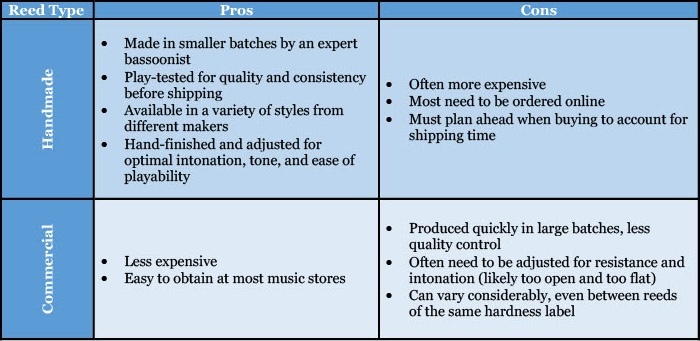
Commercial made reeds are affordable and readily available at most music stores, which makes them easily accessible, especially for new players. However, the quality and playability can vary considerably from reed to reed. Since they are not play-tested before shipping, they are more likely to have issues with the general construction- lack of symmetry between the blades, a tip opening which is too open or too closed, and length and profile dimensions which do not easily play in tune. Many commercial reeds need adjustments before they will play comfortably. Commercial reeds are fine for getting started, but are not ideal for building sustainable skills on the instrument.
Handmade reeds can be purchased online through double reed specialty retailers (like us!) or directly from a bassoon teacher or some professional bassoonists. These days, there are many different options for handmade reeds sold online, so with a bit of planning ahead of time, players of all levels can find something that suits them well. Although handmade reeds are typically more expensive than commercial reeds, the level of craftsmanship that goes into a handmade reed is well worth the price tag. Professional reedmakers devote time and expertise to produce reeds that play comfortably in tune with a beautiful sound. This level of quality control also ensures more consistency from reed to reed, even with minimal or no adjustments right out of the box.
How do I know when it's time to try handmade reeds?
We recommend switching to handmade reeds as soon as possible. For many students starting on bassoon in their school ensembles, a commercially made reed may be provided (or they will be asked to purchase one) during instrument trials or at the beginning of the school year. The sooner a student can move to handmade reeds, the sooner they will be able to start developing correct breath control, tone production skills, and intonation skills. This is especially important for students who do not have access to a private teacher.
Educators who are purchasing bassoon reeds for their school ensembles should consider buying handmade reeds right from the start. As noted above, handmade reeds are made to play reliably with little or no adjustment needed. If the budget allows for it, using handmade reeds can help set young players up for success.
Questions to consider before trying handmade reeds:
- Do my current reeds allow me to perform at my best?
- Can I play comfortably in tune on my current reeds?
- Am I looking to level up my sound?
Conclusion:
Although handmade bassoon reeds are usually more expensive, they also come with many benefits. Keep in mind that when you’re paying for a handmade reed, you’re not only paying for the materials, but also for the reedmaker’s time and expertise.
In the video below, bassoonist Dan Nguyen tests several commercially made reeds to demonstrate the pros and cons of each.
If you’re ready to upgrade, but not sure where to start, check out our Bassoon Reed Buying Guide (coming soon). We stock a variety of handmade bassoon reeds to suit the needs of even the most discerning bassoonist.
Questions? Contact us through our website. We’re happy to help!