
Book Review: The Art of Wind Playing By Arthur Weisberg
Posted by Clair Cangialosi, DMA on Mar 9th 2026
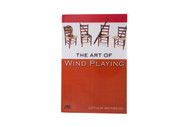
First published in 1975, The Art of Wind Playing by Arthur Weisberg offers a perspective on the fundamentals of playing a wind instrument as they relate to the interpretation of Western classical music from the eighteenth through the twentieth century. The book is intended as a resource for all wind players, as well as teachers and conductors. This blog post will provide a summary and commentary on how The Art of Wind Playing relates to modern wind pedagogy.
About the Author
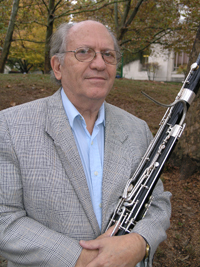
Arthur Weisberg (1931-2009) was an American bassoonist, clarinetist, conductor, composer, and author. Hailed as one of the great wind virtuosos of the twentieth century, he performed as a bassoonist with the Houston, Baltimore, and Cleveland orchestras, as well as the Symphony of the Air and the New York Woodwind Quintet. He also held conducting positions with the Milwaukee Symphony and the New York Philharmonic. Also an esteemed pedagogue, Weisberg taught at Juilliard School, State University of New York at Stony Brook, Yale School of Music, Manhattan School of Music, and Indiana University's Jacobs School of Music. (1)
Summary
The Art of Wind Playing is divided into two main sections, each with several chapters covering different topics. Although the chapters may be read in any order, first-time readers may find it helpful to start at the beginning.
Part 1: Techniques
In this section, Weisberg discusses the mechanical aspects of playing a wind instrument, which he places into one of four categories: finger technique, the use of the tongue, the use of the air, and embouchure. Each of the five chapters in part 1 is related to one of these four categories. Each chapter is further divided into several related subtopics.
Chapter 1: Dynamics & Intonation
- Dynamics
- Intonation and Pitch
- Crescendo and Diminuendo
- Accents
- Legato Playing
- Longtone Exercises
Chapter 2: Single and Double Tonguing
- Staccato
- The Tongue and the Air
- Double-Tonguing
- Attack and Release of Notes Other Than Staccato (resonance)
- A Way of Ending Dificult Soft Notes
- Attacks (different types)
- Exercises
- Combinations of Attacks and Releases
Chapter 3: Vibrato
- The Basic Pulse
- Common Faults
- Variables to Be Controlled
- Exercises (beginner, intermediate, and advanced)
Chapter 4: Technique (of the fingers)
- Playing Difficult Passages
- Embouchure and Air
- Choice of Fingering
Chapter 5: Breathing
- The Physiology of Breathing
- Making Time to Breathe
- Judging the Ammount of Air Needed
- Exercises
Part 2: Musicianship
This section is dedicated to describing the various musical styles of the five major eras of Western classical music and strategies for interpreting them. In this section, Weisberg addresses the ways in which the technical aspects of playing a wind instrument are translated into style and performance practice.
Chapter 6: Style
- Evolutuion of Style
- Renaissance
- Baroque
- Classical
- Romantic
- Contemporary
Chapter 7: Interpretation
- Time and Speed
- Time Signature-An Architectural Conception
- The Role of Attack and Release in Stressing Notes
- Other Ways of Stressing Notes
- Vibrato
- Legato Connection Between Notes
- A Practical Example
Commentary
Writing Style
Weisberg’s writing style is authoritative, but the tone is relatively informal. The intended audience is serious wind players, likely at university level or above. He provides definitions and matter-of-fact statements which are meant to be pondered by the reader and absorbed over time. Although he does make comparisons to string instruments (where a clear visual is helpful), he does not rely heavily on metaphor to convey his ideas. Instead, Weisberg works to describe the actual physical mechanics of each aspect of playing a wind instrument in broad conceptual terms.
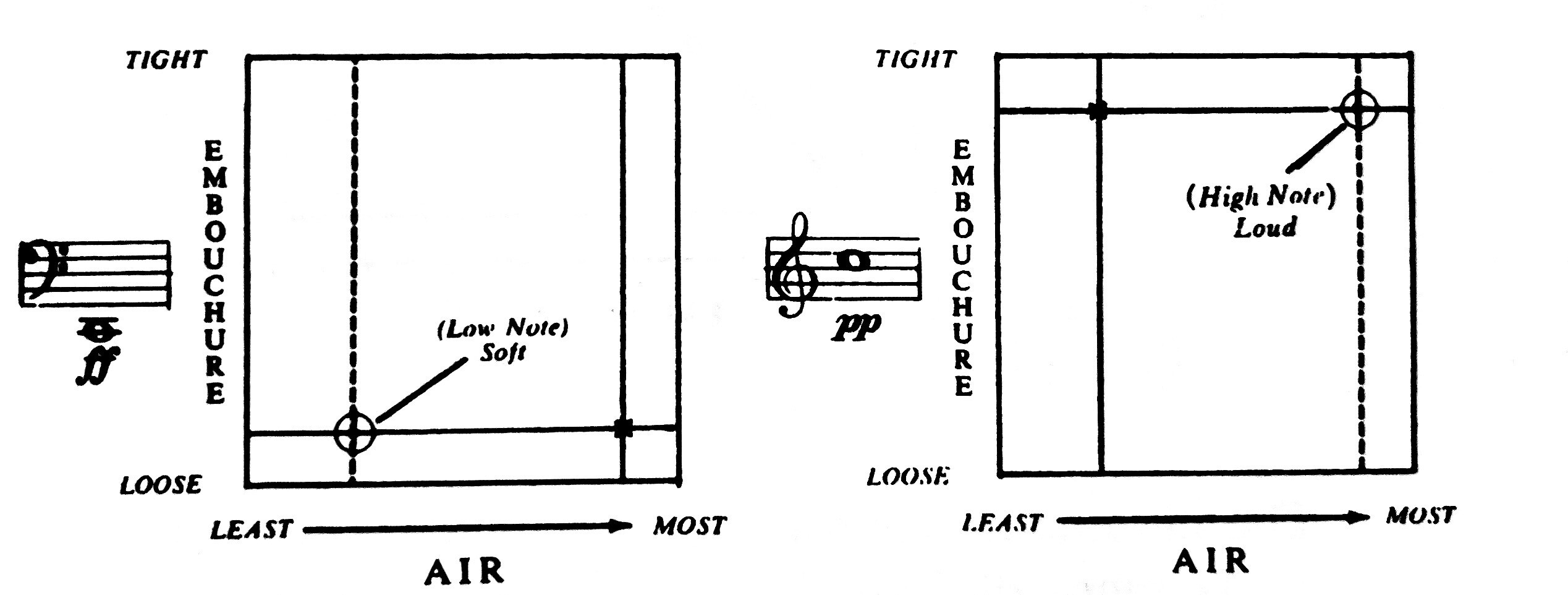
Some readers may find this book to be dry or hard to understand. Our culture and the way that we receive information from the media has changed tremendously since this book was written. It may take more focused attention than what many are used to, but this book does have many valuable insights to share. The writing style requires readers to think deeply and synthesize the information they are reading before applying it to their own playing. Weisberg’s explanations are very detailed, so close reading is essential to ascertain his meaning. Charts & diagrams are provided to elucidate some concepts, but they do not serve to replace or break up the text. It may be helpful to underline or highlight important passages in the text while reading.
Main Takeaways
Several times throughout the book, Weisberg notes that diligent practice is necessary to gain control of embouchure, air, and articulation, etc, and that it will take many months (or longer) to master these skills at a high level. He acknowledges that although variations in anatomy from person to person do impact their inherent ability, with practice and time, everyone can improve their skills by learning to control the mechanics of their instrument.
This book may be best used for informational purposes- it is not a method book. While Weisberg does provide some exercises, they are left purposely vague so that they may be applied to all wind players. It is up to the player to determine how to adapt each exercise to suit their needs. Furthermore, it seems that Weisberg assumes that his readers will already be familiar with the types of exercises he provides because he rarely includes notated music. This approach to pedagogy may be indicative of the time at which this book was written- it doesn’t promise easy solutions or step by step instructions, but instead offers broad ideas which the reader must then explore through their own practice.
Although The Art of Wind Playing is widely regarded as an essential guide to playing a wind instrument, it is not irreproachable. There are two elements which may be “taken with a grain of salt.” First, Weisberg notes that vibrato and double tonguing are “completely unknown to many players.” (2) This may have been the case in 1975, but by today’s standards they are both regarded as standard essential techniques for the professional double reed player. Secondly, Weisberg uses “he” as a generic pronoun. Although at the time this book was written, it was standard practice to use “he” as a gender neutral pronoun, it is now considered to be outdated. Unfortunately, Weisberg had already passed away before widespread use of gender neutral pronouns in formal writing.
Conclusion
Considering purchasing your own copy of The Art of Wind Playing? Here’s a quick breakdown:
- The Art of Wind Playing covers the technical aspects of playing a wind instrument as well as descriptions of the major stylistic eras of Western Classical music.
- The book is Intended for advanced wind players, teachers, and conductors
- Weisberg discusses broad concepts, which serve as a guide in structuring one’s own practice
Works Cited
- Arthur Weisberg” Indiana University Media Relations. Indiana University, 2005. Accessed via theWayBackMachine Internet Archive: http://newsinfo.iu.edu/sb/page/normal/971.html
- Weisberg, Arthur. The Art of Wind Playing. Galesville, MD: Meredith Music Publications, 2007, viii.